
OneSat
High flexibility to adapt to changing missions

Fully reconfigurable in orbit
Airbus’ OneSat is a geostationary satellite, meaning that it orbits at 36,000km above the Earth and can cover the entire globe with just three satellites. It can be fully reconfigured in orbit, capable of adjusting the coverage area, capacity and frequency “on the fly” to meet evolving mission scenarios.
It builds on Airbus’ heritage of highly reliable Eurostar telecommunications satellites and the company’s constellation expertise with OneWeb. OneSat is based on a standardised, modular and design-to-manufacture approach.
It comes with a ground system and software suite to take advantage of the full flexibility of the satellite.
Video Gallery
-
 OneSat - New generation telecommunication satellite
OneSat - New generation telecommunication satellite
-
 ONE SAT
ONE SAT
Telecommunications satellite that keeps you connected to the world


AD 20230612 OneSat BARFAS RF
OneSat for website
Key benefits
- One single generic design
- Supply chain and production line up to speed
- Software-defined solution
- End-to-end solution and software tool suite for optimised operations
- Continuous Airbus support for unrivalled customer experience
- High flexibility for mission evolution in orbit
- 100% all-electric propulsion
- Satellites can be launched in pairs

Media Centre
Browse our photos, videos and downloadable assets of OneSat.
The latest OneSat news
In the spotlight
-

Airbus-built OneSat selected for the first Omani satellite
Press Release
Space
Oman’s national satellite operator, has awarded a contract to Airbus Defence and Space for OmanSat-1 telecommunication satellite, the 10th OneSat order. -
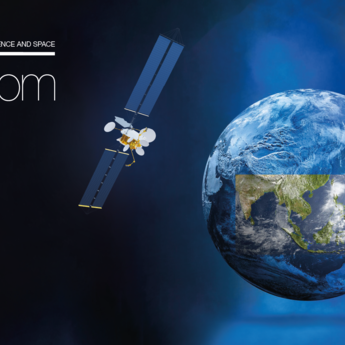
Thaicom contracts Airbus for a OneSat flexible telecommunications satellite
Press Release
Space
-

#NextSpace: One sat for all
Web Story
Space
-

OneSat Final Design Review successfully achieved
Press Release
Company
-

SKY Perfect JSAT signs contract with Airbus to build Superbird-9 telecommunications…
Press Release
Space


Discover more about telecommunications and navigations satellites
-

Low Earth orbit satellite constellation
Airbus’ low Earth orbit constellation satellites offer a variety of communications, maritime and aeronautical applications.
-

Military Space
Airbus’ space-based assets ensure constant communication, connectivity and surveillance for military operations on land, at sea,…
-

Space Data Highway
The Space Data Highway allows a high-volume data transfer via ultra-broadband laser communications.
-

Galileo
The European Galileo satellite navigation system enables high-precision navigation, positioning and timing services.
-

EGNOS V3
EGNOS V3 is a satellite-based augmentation system that provides the highest-precision navigation and positioning services.


Frequently asked questions
About OneSat
What is the Airbus OneSat satellite?
OneSat is a next-generation geostationary (GEO) telecommunications satellite developed by Airbus. Unlike older, hard-wired spacecraft designed for a single, fixed mission, OneSat is a fully software-defined satellite (SDS).
Operating at 36,000 kilometres above the Earth, it uses a standardised, modular architecture that allows operators to completely reprogramme and reconfigure its entire payload from the ground while it is active in space. Supported by the European Space Agency (ESA) as well as the French Space Agency (CNES), the UK Space Agency, the German Space Agency (DLR) and Spain Space Agency (AEE), OneSat represents a disruptive evolution in global satellite connectivity.
What frequency bands does OneSat operate in?
The Airbus OneSat platform operates across Ku-band and Ka-band for users missions and Q-band and V-band frequencies for gateway data transfer, the industry standards for high-capacity global communications.
Because the satellite is entirely software-defined, operators do not have to pick a single fixed configuration. They can dynamically manage and split these frequencies from the ground based on market needs:
- Ka-Band: Optimised for ultra-high-speed consumer broadband, 5G connectivity, and cellular data networks.
- Ku-Band: Ideal for high-reliability mobile services, such as commercial in-flight Wi-Fi, maritime shipping communications, and secure government connectivity.
What makes OneSat different from a traditional satellite?
Traditional telecommunications satellites are custom-built for a single, unalterable mission. Once launched into geostationary orbit, their coverage areas and frequencies are "locked in" for 15-year lifespan.
OneSat represents a paradigm shift as a software-defined satellite (SDS), its configuration can be reprogrammed while in-orbit, adjusting its coverage, capacity and frequency ‘on the fly’ to meet evolving mission scenarios.
What can a software-defined satellite do in-orbit?
It gives operators control to meet evolution of the mission. While in orbit, OneSat can modify three core performance capabilities:
- Reshape coverage beams: alter direction of its signal to track specific high-traffic areas on a specific city or a busy shipping lane.
- Modify frequencies: adjust radio frequencies to bypass local signal interference or comply with changing regional regulations.
- Reallocate capacity: If a major event creates a sudden spike in data demand, the satellite can "beam" extra power to that exact location.
How does OneSat help bridge the digital divide?
Because OneSat is highly efficient and flexible, it significantly lowers the "cost per bit" of data. This makes it much more affordable for operators to provide high-speed internet to remote villages, schools, and hospitals that are currently offline. OneSat can be moved or reconfigured to serve different regions as connectivity needs grow.
Which operators have selected Airbus OneSat technology?
As the telecommunications market shifts toward software-defined infrastructure, OneSat is setting the new industry standard for flexible, geostationary satellite design. It has been selected by major international operators including SES, Viasat, Thaicom, and most recently for OmanSat-1.
Can OneSat be used for applications beyond the consumer internet?
Absolutely. While it is a powerhouse for broadband and 5G connectivity, its flexibility makes it ideal for:
- In-Flight Connectivity (IFC): Keeping passengers connected on planes across oceans.
- Maritime services: Providing reliable data for cargo ships and cruise liners.
- Government & Defence: Allowing secure, reconfigurable communications for humanitarian or national security missions.