
Beyond connectivity: elevate the passenger experience and aircraft operations

Passengers expect their in-flight connection to work just like it does at home. At the same time, airlines require accurate operational visibility and performance data. Being part of a wide and complex digital ecosystem, the Airbus Connected Aircraft ambition is shifting the aviation industry from closed systems towards open, adaptable architectures. Unifying hardware, software and satellite networks allows Airbus to connect aircraft end-to-end, so airlines can leverage digital and connectivity to offer a reliable digital experience and boost their operational efficiency.

Aircraft connectivity infographic
Overcoming the challenges of in-flight connectivity
Upgrading an aircraft's satellite connectivity historically meant grounding the plane for extensive structural changes. This is because each antenna required a customised mounting plate and cabin installation that was specific to each satcom provider. Airlines often found themselves locked into a single vendor, making it difficult to keep pace with rapidly advancing technology. Consequently, upgrading on board connectivity was a complex and expensive challenge.
Open architecture and the new digital platform
Today, Airbus provides an aviation-grade connectivity installation called HBCplus offering the flexibility to connect to multiple satcom providers which can operate in low, middle or geostationary orbits. This means an aircraft satcom access is no longer tied to one single network in operations.
As a next step, Airbus is developing a new modular approach for its HBCplus connectivity system that will enable access to major LEO constellations, including Amazon LEO, OneWeb,Telesat and SpaceSail. Thanks to its modular design, it can accommodate up to two antennas and connect to multiple satellite systems, giving airlines the flexibility to choose and update their vendor with an overnight retrofit.
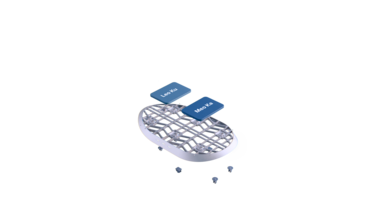
HBCplus modular
In the meantime, Airbus will also introduce a new open and scalable platform. Built as an end-to-end integrated operating system, this platform aggregates and manages data by combining onboard systems, on-ground systems, artificial intelligence and IoT, eg. sensors and cameras. This turns the aircraft into a powerful digital asset where airlines can upload existing Skywise or third parties’ applications or develop their own.
Delivering a seamless passenger experience via LEO, MEO and GEO satellites
For passengers, this translates directly into a better and seamless flight. To provide a reliable connection globally, the Airbus Connected Aircraft uses a combination of different satellite orbits.
A major focus is Low Earth Orbit (LEO) technology. Orbiting at roughly 500 to 2,000 kilometres altitude, LEO constellations consist of hundreds of moving satellites. Being closer to the Earth means they offer very low latency. They also provide global coverage, ensuring a connection even over remote polar routes.
The system also utilises Medium Earth Orbit (MEO) satellites at approximately 8,000 kilometres for high throughput, alongside Geostationary Earth Orbit (GEO) satellites positioned 36,000 kilometres above the equator to complement bandwidth for specific usage cases. For example, MEO offers a round-trip latency of about 150ms. While not as fast as LEO (<50ms), it is significantly better than GEO (>600ms) and more than sufficient for high-speed video conferencing and seamless internet browsing.

Aircraft connectivity constellations infographic
Empowering airlines to personalise the passenger journey
The next iteration of HBCplus, planned to enter into service in 2028, will incorporate a modular antenna system system based on "Electronically Steered Antenna" (ESA) technology. This allows airlines to leverage different service providers and satellite orbits in a flexible manner, while providing optimum speed, cost and geographic coverage.
"Connectivity is a fast moving market, with new service providers and antenna technologies evolving rapidly. Thanks to our HBCplus modular solution, we will provide our customer with a flexible platform, providing access to the most competitive technology and service provider options at all times." says Tim Sommer, Airbus Vice President and Head of Connected Aircraft Programme.
This modular and flexible solution protects the airline's assets. Changing to a new service provider or antenna technology is easy and fast. For example, if a new satellite network becomes available, the airline can swap its service provider using this agnostic installation without needing structural modifications to the airframe.
The open digital platform helps airlines turn onboard data points into practical insights. This has a dual impact: it optimises daily operations while personalising the passenger journey. For instance, Airbus and Virgin Atlantic are currently partnering on a specific use case: through the Smart Catering application, they manage inventory and reduce unconsumed food and beverage, while simultaneously ensuring passengers have the power to choose their preferred meals.
Connected aircraft video

Airbus Connectivity Solutions
Aircraft connect the world. Now we connect the aircraft.
Discover Airbus Connectivity Solutions. Own network choice, data intelligence and never be locked to a single provider.
Download Airbus connectivity update & news assets
Download
Future-proofing Airbus’ connected aircraft for and beyond connectivity
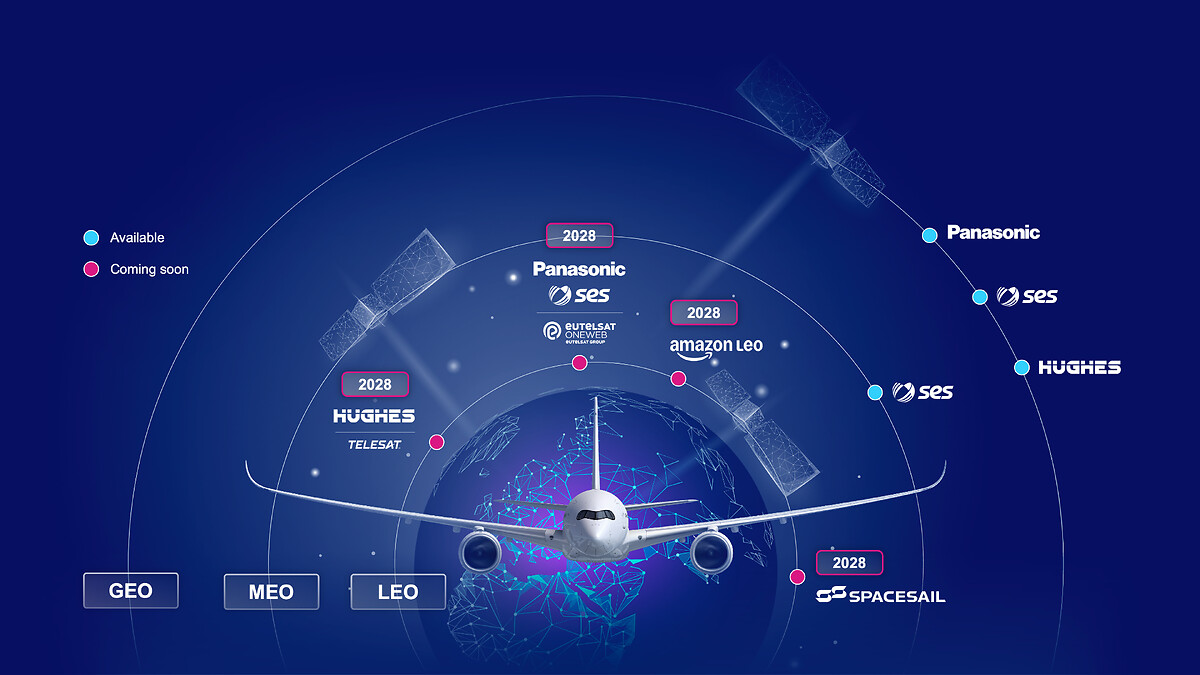
Aircraft connectivity constellations infographic
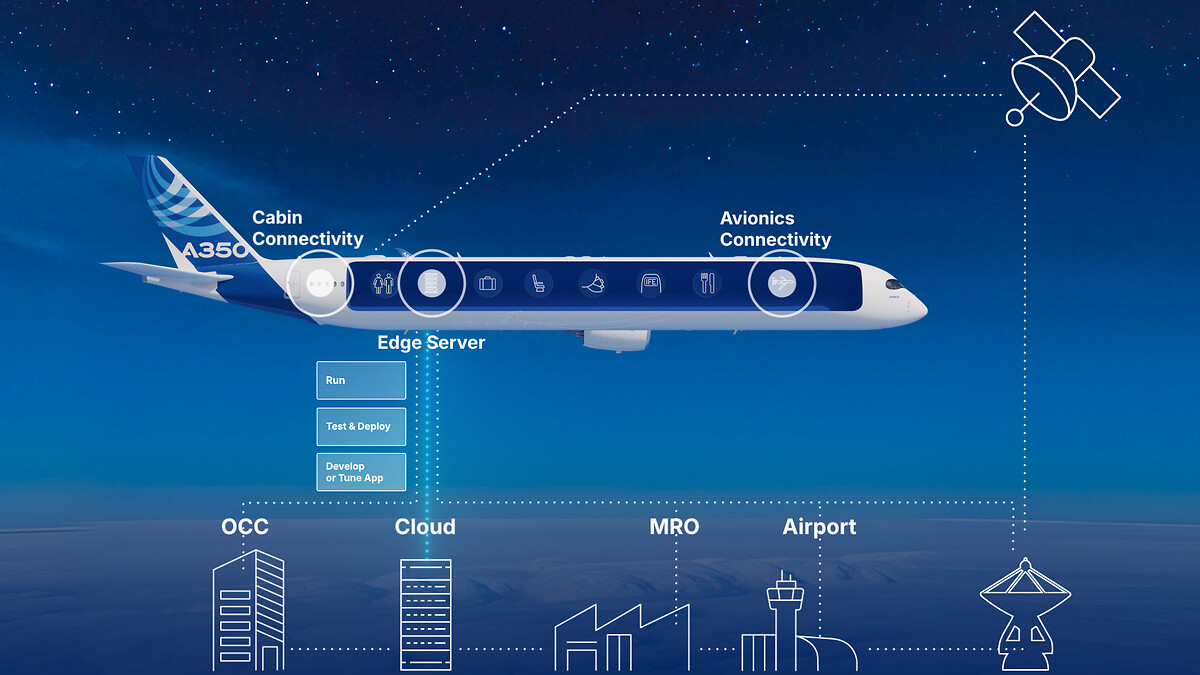
Aircraft connectivity infographic
Download
Future-proofing Airbus’ connected aircraft for and beyond connectivity
Aircraft connectivity constellations infographic
Aircraft connectivity infographic
Discover more
-

Connectivity
-

Airbus Services
Explore the full scope of Airbus Services. We provide technical aviation services, pilot training, aircraft maintenance, and…
-

Airbus at Aircraft Interiors Expo 2026
Join Airbus in Hamburg from 14 April to 16 April 2026 to explore the aircraft cabin design, connectivity solutions and accessible…
-
Pioneering global connectivity through terrestrial and non-terrestrial networks
Airbus is pioneering global connectivity with integrated terrestrial and non-terrestrial (NTN) networks, 5G/6G research, and…


Read more
-

How does the cabin air system work?
Web Story
Commercial Aircraft
Find out more about cabin air system in an aircraft. -

Canada’s CT-153 Juno gets ready for training
Web Story
Helicopters
-

Behind your boarding pass
Web Story
Commercial Aircraft
-

Training the next generation of pilots, technicians and cabin crew
Web Story
Commercial Aircraft
-

The Airbus H160: redefining mission readiness and support
Web Story
Helicopters
