
Pioneering global connectivity through terrestrial and non-terrestrial networks
Airbus is working to deliver seamless digital connectivity anytime, anywhere.

To enable the evolution towards more efficient and digital aircraft operations and improve passenger experience, Airbus is developing solutions that will provide global connectivity. This will form an integrated network of air, ground and space systems that will eliminate coverage gaps, ensuring ubiquitous gate-to-gate connection.
The future of connectivity lies in a holistic approach that will integrate and connect terrestrial and non-terrestrial networks. The former uses ground based infrastructure like mobile phone towers or fibre-optic cables. In contrast, non-terrestrial networks (NTN) use satellites to connect areas that can’t be reached by cables – such as the sky or the sea – providing connectivity unbound by location.
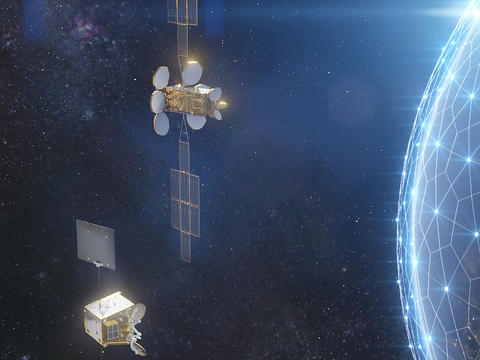
NTN satellite constellations like Eutelsat’s OneWeb operate in low Earth orbit (LEO), located 2,000 kilometres or less above the Earth. These constellations are made up of groups of interconnected satellites, forming a network that covers the entire planet. Satellites placed in LEO have high-bandwidth capacity and provide minimal communication delays. They essentially function as floating mobile phone towers, allowing for constant and reliable connectivity that remains stable even as an aircraft travels across continents and oceans.
A fully connected experience
While these constellations play a significant role in expanding reliable internet access, they also have the potential to improve how aircraft are operated and maintained, as well as the passenger experience. Modern aircraft rely more and more on data connectivity for everything from flight safety and operations to entertainment systems for passengers.
A more personalised experience for passengers
Airbus is increasingly reimagining the in-flight experience as a premium, fully connected digital journey that mirrors the experience passengers have on the ground. Just as phone networks transition seamlessly from 5G to WiFi or from one country to another, Airbus is working on a fully connected cabin that will permit easy connection of wireless devices in all flight phases. This connection will be regulated by aviation industry standards for reliability and cybersecurity.
Increased connectivity for flight and cabin crew
Pilots will also benefit from increased connectivity, with uninterrupted data flow between the flight deck and operational control centres. By consolidating all information needed by pilots on a central display within a single application, pilot tasks are streamlined and flight is optimised. This improved connectivity across the flight deck results in pilots being able to access connected charts, updated weather, real-time airport information in case of rerouting, and even the possibility to interface with apps.
Meanwhile, enhanced cabin connectivity allows crew to shift focus from logistics to personalised passenger care. With real-time data and AI, crew can proactively resolve travel disruptions, such as delays or lost baggage, and optimise catering on board.
Improved operational efficiency
From ground crew and cargo uses to serving cabin and flight crews, secure and reliable communications are the lynchpin of aircraft operations. Operational teams can reap massive benefits from a hyperconnected environment through data-driven platforms like Airbus Skywise, which make it possible to leverage all the data generated by aircraft and the airport ecosystem into in-depth analyses. These conclusions can be used to improve operations by reducing fuel burn, identifying and reducing potential failures, minimising delays and more.
Global communications for operations
The integration of ground and satellite networks also serves as the backbone for mission-critical solutions like Agnet by Airbus. By integrating mission-critical services into the global network, Agnet enables seamless, secure, and instantaneous collaboration (including voice, data, location and real-time video) between teams such as flight operations, maintenance crews, and security services, providing end-to-end security and reliable group collaboration.
Digital Connectivity
Standardising connectivity
In the last five years, the number of communication satellites orbiting in LEO has vastly increased, lowering costs for customers to a level comparable with 5G on the ground. Satellite connectivity is increasingly accessible to everyone, and Airbus aims to leverage this to supply all future aircraft with a standard level of connectivity – much like how new cars come with their own connected maintenance and navigation system.
Airbus is helping to implement this transition by fostering the development and launch of an in-orbit demonstrator of a future standard and interoperable NTN network. This includes supporting the industry standardisation of 5G NTN, which will guarantee interoperability between operators and reduce roadblocks to operating across different countries.
Leading innovative 5G and 6G research
The first steps towards this NTN network have already taken shape: Airbus, Eutelsat and Mediatek announced the world’s first successful trial of 5G NTN technology at the end of February 2025. The test used Eutelsat’s OneWeb LEO satellite constellation, built by Airbus.
Then, in January 2026, the Airbus UpNext SpaceRAN demonstrator was launched to optimise routing and reduce end-to-end latency on this NTN network. Unlike current satellite systems, which have to relay signals back to Earth, Airbus UpNext SpaceRAN will demonstrate the ability to process data immediately in space with software-defined satellites. This reduces the time it takes for data connections to be made, known as latency, and maximises the amount of information that can be sent.
This kind of progress in the 5G space is serving as a complementary step for the 6G for Connected Sky project. Coordinated by Airbus, the project demonstrated different 6G connectivity approaches, including ultra-reliable multipath connections for drones via LEO satellites, ground-based mobile phone towers, and mesh networks. It also validated the use of High Altitude Platform Stations (HAPS) for stratospheric connectivity and showcased the potential of integrated sensing and communication for optimising airport operations. Further breakthroughs included 6G-enabled drone swarms, explainable AI* for network reliability, and the development of an antenna array designed for direct air-to-ground communication.
Airbus already offers High-Bandwidth Connectivity Plus (HBCplus), the first multi-orbit offboard connectivity solution to connect aircraft with most satellite constellations
Looking toward the future
In the coming years, aircraft operations will become increasingly connected and digitised and Airbus is playing a key role in this transition. Airbus is active in several organisations shaping the standardisation of this technology. With major leaps forward in connectivity on the horizon, the only thing that is certain is that aviation and other global mobility industry segments will soon be more connected than ever before.
*Explainable AI models show the underlying processing that led to the final output. Since AI will be part of 6G, this is particularly important for aviation safety and mission-critical services.

Airbus NOVA Newsletter
Your go-to source for the latest stories on disruptive technologies and ground-breaking aerospace projects that will transform the way we fly.
Discover more
-

Connectivity
Airbus specialises in secure, multi-orbit, multi-domain connectivity across the world's land, sea, air and space domains.
-
Telecommunications and Navigation satellites
Airbus is a global leader in communications and navigation satellites, delivering high-performance products and solutions to…
-

Low Earth orbit satellite constellation
Airbus’ low Earth orbit constellation satellites offer a variety of communications, maritime and aeronautical applications.


The latest in innovation
In the spotlight
-

Airbus kicks off wing facility extension, with major investment into Belfast site
Press Release
Commercial Aircraft
Construction has started on a 6,221 sq m extension at Airbus’ Belfast wing facilitym to support the A220 production ramp-up. -

Airbus elevates hybrid-electric integration with LEIA Project
Press Release
Innovation
-

Airbus unveils study on the potential of sustainable aviation fuel to support…
Press Release
Innovation
-
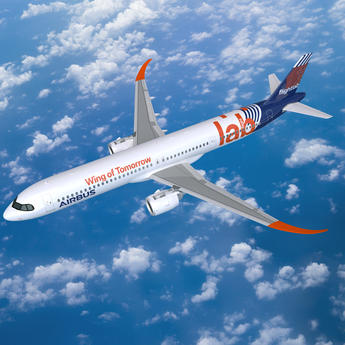
Airbus launches new flight test programme for Wing of Tomorrow
Press Release
Innovation
-

Air Canada and Airbus launch joint initiative to scale domestic Canadian SAF and…
Press Release
Innovation

