
Eurofighter
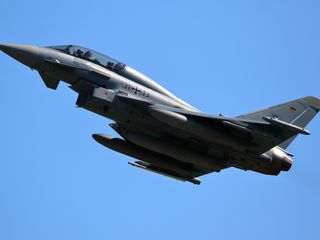
Eurofighter Typhoon

The leading swing-role fighter
A multinational programme
The Eurofighter Typhoon is the world's most advanced swing-role combat aircraft. Originally conceived as a multinational programme to modernise the air forces of European industrial partner nations, the Eurofighter Typhoon has now been sold to six additional customers (Austria, the Kingdom of Saudi Arabia, the Sultanate of Oman, Kuwait, Qatar and Turkey), doubling the number of original user nations.
It is powered by two EJ200 engines which give the Eurofighter Typhoon its impressive thrust-to-weight ratio and manoeuvrability. At the heart of this state-of-the-art weapon system is its identification and sensor fusion capability, based on the CAPTOR-E AESA radar and the PIRATE FLIR sensor, protected by the PRAETORIAN Electronic Defensive Aid Sub System (DASS). No other fighter has integrated such a large number of European and U.S. weapons, making it combat-ready for any mission.

Orders and Deliveries
Total Orders: 769
Combat-ready for any mission
Air superiority
In the air superiority mission, the Eurofighter Typhoons are typically equipped with air-to-air missiles for beyond-visual-range and close combat. It is the combination of thrust, agility, manoeuvrability, advanced sensors and data fusion that makes the Eurofighter Typhoon the superior air combat platform.

Air interdiction
In the air interdiction role, the Eurofighter Typhoon is configured for ground attack and although it is equipped with a targeting pod and up to 4 ground attack weapons, it still carries 4 radar and 2 infrared missiles.

Close air support
With the integration of new advanced missiles, the Eurofighter Typhoon has enhanced its close air support capabilities, enabling it to engage with reduced risk of collateral damage to non-combatant or friendly forces.


Eurofighter Typhoon - Swing Role
Swing role
Eurofighter
The Eurofighter Typhoon can easily switch from air-to-air to air-to-surface and back again within the same mission.
Multiple configurations of air-to-air and ground-attack payloads can be accommodated under 13 wing and fuselage stations, providing a highly flexible and mission-specific configuration.
Discover more about Eurofighter
Eurofighter Combat


Two Eurofighter Typhoon flying together
Eurofighter Typhoon
Best European technology
The Eurofighter Typhoon represents the best of British, German, Italian and Spanish technology. As Europe's largest military joint programme, it excels in avionics, aerodynamics, materials and engines.
Offering unrivalled operational capability and fleet effectiveness, the Eurofighter Typhoon sets the standard for new generation combat aircraft.


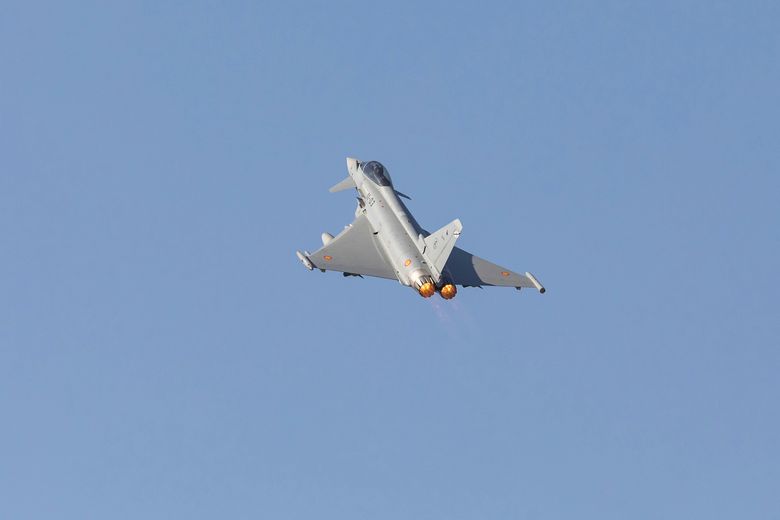
Eurofighters of the Spanish Air Force flying together
Eurofighters of the Spanish Air Force.
Eurofighter Typhoon´s most outstanding features
Eurofighter Typhoon
- Advanced modular avionics and digital flight control system.
- Super-cruising multi-role capabilities.
- State-of-the-art human-machine interface includes LCD screens, hands-on throttle and stick, helmet-mounted display and voice input.
- With AESA radar, infra-red search and tracking system and advanced sensor data fusion, it offers extensive weapon options on 13 hardpoints.
- Its stealthy design, powerful engines and mission-tailored defences ensure high survivability and low operating costs.
Discover more about Military Aircraft at Airbus
Defence Portfolio
-
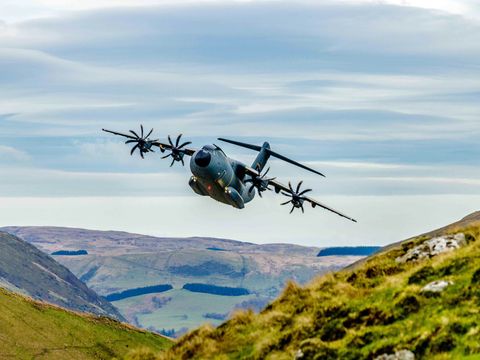
A400M
The Airbus A400M is the most advanced airlifter, capable of carrying strategic loads, delivering to unprepared airfields and…
-
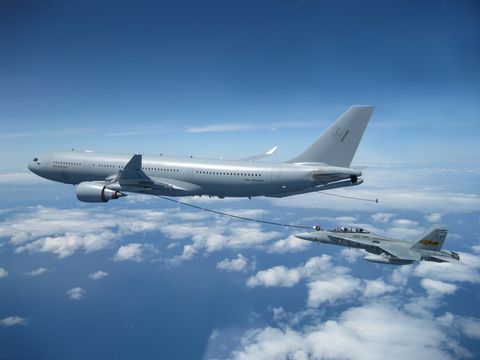
A330 MRTT
A combat-proven, highly versatile tanker based on the A330-200, the A330 MRTT sets the benchmark for multi-role tanker aircraft.
-
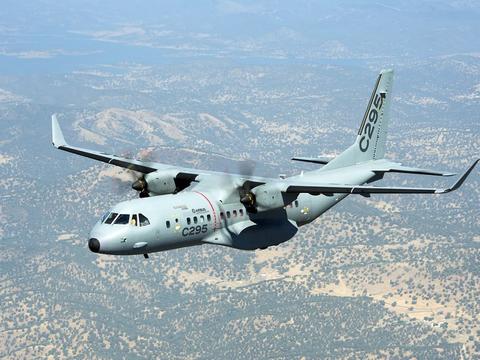
C295
The Airbus C295 tactical airlifter: Robust, reliable, and versatile, capable of performing various missions in all weather…
-

Military Aircraft Services
Airbus supports the world's air forces with major customer support centres on five continents.


The latest Eurofighter news
In the spotlight
-

Timber Express: Virtual battlespaces as the future of testing and training
Web Story
Defence
Real jets, synthetic threats: Airbus supported the Timber Express exercise of the German Air Force in summer 2026 and trialled a new digital paradigm. -

“I pushed it to its limits”: On board the maiden flight of the Quadriga Eurofighter
Web Story
Defence
-

Sovereign defence systems and civil aviation innovation: Airbus at ILA 2026
Web Story
Innovation
-

Airbus is preparing two uncrewed combat aircraft from Kratos for first flight with a…
Press Release
Defence
-

Air policing in Romania: “With the Eurofighter we can respond at a moment's notice”
Web Story
Defence

The Eurofighter around the world
Image gallery
-


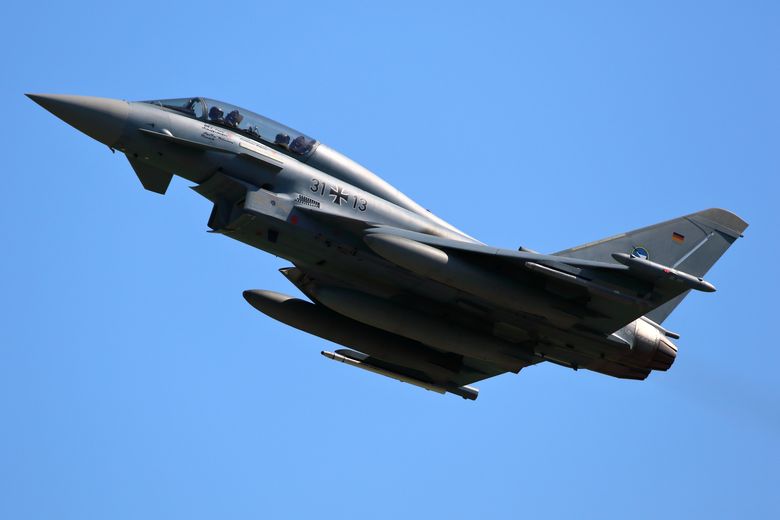
Eurofighter in Pitch Black 2024 04
-


Royal Air Force Eurofighter - Pitch Black 2024
A Royal Air Force pilot from No. 11 Fighter Squadron conducts pre-flight checks in a Eurofighter Typhoon FGR4 during Exercise Pitch Black 24, RAAF Base Darwin.
-


German Eurofighter in Pitch Black 2024
-


RAF Eurofighter in Pitch Black 2024
-


Eurofighter in Pitch Black 2024 02
-
-


Frequently asked questions
Eurofighter
What countries currently operate the Eurofighter Typhoon?
The aircraft was developed by a consortium of four nations: the UK, Germany, Italy and Spain. It has since been exported to a further six nations: Austria, Saudi Arabia, Oman, Kuwait, Qatar and Türkiye. This brings the total number of global operators to ten.
Why is it called a "swing-role" fighter?
Unlike traditional multi-role combat aircraft that are optimised for a single mission profile and merely capable of another, a swing-role fighter can accomplish air-to-air and air-to-surface roles simultaneously. The aircraft can track and engage airborne threats midway through a ground-strike mission without requiring any manual system reconfiguration.
How fast can the Eurofighter fly?
The aircraft is capable of reaching a maximum speed in excess of Mach 2. During normal operational profiles, standard speeds of approximately Mach 1.68 are typically maintained.
How does it perform in combat?
The Eurofighter's deliberately unstable airframe design gives it great agility in combat. This design enhances manoeuvrability at subsonic speeds while ensuring excellent aerodynamic efficiency at supersonic speeds.
What is the role of the Eurofighter in European strategic autonomy?
The Eurofighter is Europe's largest military programme and serves as a vital cornerstone for collective security. The aircraft is actively deployed to defend NATO's eastern flank and secure sovereign airspace around the world. Built on a multi-nation collaborative foundation, the platform embodies European industrial expertise and ensures the region maintains independent defence capabilities in an increasingly unstable global landscape
Is the Eurofighter Typhoon deployed in Ukraine?
No, the Eurofighter Typhoon is not operated by Ukrainian forces or deployed directly within Ukraine. However, the platform plays a vital role in European security and collective deterrence in response to regional instability. Since 2022, NATO air forces – including the German Air Force and the Spanish Air and Space Force – have actively deployed Eurofighters to reinforce NATO's eastern flank. Operating from strategic locations such as Romania and the Baltic states, these aircraft perform continuous Quick Reaction Alert (QRA) and air policing missions to protect allied airspace, intercept unauthorised aircraft, and guarantee regional stability.
Can the Eurofighter participate in manned-unmanned teaming missions?
Yes. As the battlespace becomes increasingly data-driven, the Eurofighter is evolving to act as a central node in complex combat networks. Future capability upgrades will focus on crewed-uncrewed teaming, also known as Manned-Unmanned Teaming (MUT), which will allow pilots to command autonomous uncrewed aerial systems directly from the cockpit. In collaboration with Kratos, Airbus is developing a plan to team the Eurofighter with the Valkyrie Uncrewed Collaborative Combat Aircraft (UCCA) for the German Air Force by 2029, using Airbus's proprietary MARS mission system.
In what ways is the Eurofighter connected to future combat air initiatives?
The operational insights and technological innovations pioneered through the Eurofighter programme provide a direct link to next-generation capabilities. The aircraft provides the basis for Europe’s sixth-generation fighter within the FCAS system of systems environment, where crewed and uncrewed aerial systems, as well as space assets, will be integrated to achieve information superiority. The Eurofighter's ongoing industrial activity also ensures Europe retains its cutting-edge manufacturing skills and engineering expertise.
How does Airbus support the continuous enhancement of the aircraft's capabilities?
Airbus Defence and Space ensures that the Eurofighter remains a cutting-edge platform capable of countering evolving threats. Through continuous modernisation programmes, the company integrates advanced radar architectures, enhanced avionics and updated defensive aid subsystems. This sustained focus on technological innovation guarantees operational excellence throughout the fleet's operational life cycle.
What is the economic impact of the Eurofighter programme and how many jobs does it support?
As Europe’s largest military aviation programme, the Eurofighter Typhoon drives industrial innovation and sovereign capability. The programme secures over 100,000 jobs across Europe within a specialised supply chain of more than 400 aerospace companies. National investments yield major returns: a PricewaterhouseCoopers study showed that the German Tranche 4 programme contributed € 6.5 billion to German gross domestic product (GDP) and 26,000 jobs by 2060, while Spain's Halcón contracts will secure 26,000 Spanish jobs, contributing nearly € 1.7 billion to GDP.