
Artemis II lifts off: destination Moon with the Orion spacecraft!
Discover how the Airbus-built European Service Module (ESM) is supporting the crew throughout this historic 10-day lunar flyby mission.

Reid Wiseman, Victor Glover, Christina Koch, and Jeremy Hansen have taken off from Kennedy Space Center, bound for the Moon. More than 50 years after Apollo, this first crewed flight beyond low Earth orbit marks a historic milestone for NASA’s Artemis programme. The stakes are twofold: to validate the Orion spacecraft's systems and hardware essential for astronaut survival in deep space, and to pave the way for the critical docking demonstrations of the Artemis III mission.

Official crew portrait for Artemis II - © NASA JSC - Josh Valcarcel
A complex ten-day mission
Reaching lunar orbit requires a spacecraft far more sophisticated than those used to reach the ISS. Orion must travel to the Moon, more than 400,000 kilometres from Earth, perform a loop around it (the lunar fly-by), and return safely to Earth.
For this journey, the crew relies on a key part of the spacecraft: the European Service Module (ESM), designed and built by Airbus on behalf of the European Space Agency (ESA). Its contribution begins at the very start of the voyage, providing the vital elements for survival: air, drinking water, power and a regulated temperature within the crew module.

Artemis II mission journey
The Orion spacecraft will orbit Earth several times, then embark on a four-day journey to the Moon, fly around our natural satellite, and return to Earth. During this flight, the crew will test the Airbus-built European Service Module (ESM) in real conditions, validating its performance as the spacecraft's vital engine room and life-support system.
The Airbus-built European Service Module (ESM) role in NASA’s Artemis II mission.
Day 1: From solar deployment to manual piloting in high Earth orbit
After separating from the SLS rocket, the ESM deploys its four solar arrays, manufactured by Airbus Netherlands. Without them, Orion could not function. These wings convert solar energy into electricity to power the entire spacecraft and its systems, including the onboard computers, thermal control, communications and navigation. They also charge the batteries, which are essential when the spacecraft is in shadow and not visible to the Sun.
These moveable wings continuously track the Sun but can also be folded back to protect them from physical stress. This is the case during the perigee raise manoeuvre, when the rocket's upper stage, the Interim Cryogenic Propulsion Stage (ICPS), ignites to propel Orion into a high Earth orbit, generating an acceleration force that requires the arrays to be secured.
Astronauts at the helm
While the avionics and thrusters ensure autonomous navigation for almost the entire journey, a key objective of Artemis II is to test manual piloting. This is a vital step for future complex dockings such as with the future Starship and Blue Moon lunar landers.
In practice, the crew performs a manoeuvre called a ‘proximity operations demonstration’. After separating from the ICPS, the spacecraft performs a full turnaround to face the launcher’s upper stage and use it as a target. The astronauts then manually pilot the 25-ton spacecraft. Using cameras and laser systems, they bring Orion to within just 9 metres of the rocket stage to test the software, responsiveness, and lateral movement in the vacuum of space.

Artemis II piloting demonstration test - © NASA
Days 2-5: Transit to lunar orbit
After returning to automatic control, the ESM’s main engine propels the crew out of Earth orbit towards the Moon. During this four-day transit, the ESM performs three trajectory corrections. Meanwhile, the astronauts don't just wait, they conduct ‘return-operation’ demonstrations, where they practice the procedures needed for their high-speed reentry into the Earth’s atmosphere and splashdown. This includes medical drills, such as resuscitation, to practice life-saving techniques in microgravity and in the confined space of the Orion capsule. On the fifth day, Orion enters the lunar sphere of influence, where the Moon's gravitational pull becomes stronger than that of the Earth.
Day 6: A lunar fly-by
The astronauts loop around the Moon at a distance no human has approached in over half a century. At this range, the Moon appears to the crew to be the size of a basketball held at arm's length. As they pass behind the far side of the Moon, communications with Earth are cut, and the energy stored in the batteries by the solar arrays becomes vital. Alone, the crew observes the far side of the Moon and collects precious data for scientists on the ground.
Days 7-10: Returning to Earth
Orion begins its return at speeds of up to 40,000 km/h, using the Earth-Moon gravity to return naturally and limit fuel consumption. As with the outward journey, the ESM precisely adjusts the trajectory to ensure a safe return to Earth. On day eight, the crew performs a radiation shielding demonstration, practicing how to quickly build a storm shelter using on-board equipment to protect themselves from solar flares. During this exercise, the ESM’s life-support systems are vital, working at peak capacity to ‘scrub’ the air and regulate the temperature while the entire crew is huddled in this confined space.
Day 10: Separation
The ESM separates from the crew module before burning up in the Earth's atmosphere. Orion continues its re-entry, facing extreme temperatures of over 2,500°C before deploying its parachutes to slow down for a splashdown in the Pacific Ocean, where the crew will be recovered.
This voyage will confirm the reliability of Orion’s critical systems and the impact of deep-space flight on the physical and psychological health of the astronauts. The success of this mission rests on European industrial excellence: through the ESM, ESA, Airbus and its partners are demonstrating that Europe is a key partner in global lunar ambitions.
Artemis II thus opens the way for the next challenges ahead demonstration mission, Artemis III’s in-orbit lander docking tests, followed by Artemis IV and the return of humanity to the surface of the Moon.

Follow the Artemis II mission with Airbus
Orion spacecraft set to embark on historic crewed lunar flyby
-


Artemis II launch
-


Official crew portrait for Artemis II - © NASA JSC - Josh Valcarcel
-


Artemis II launch


Discover more
-
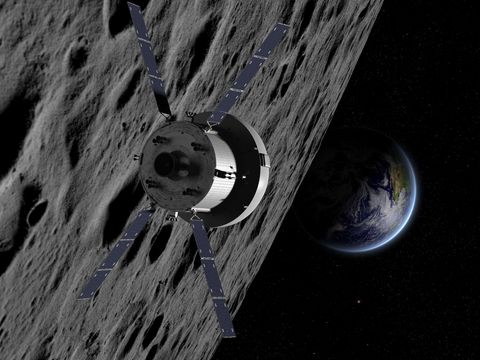
Orion European Service Module
NASA’s Orion will take humans back to the Moon. Airbus-built European Service Module provides propulsion, power, water and oxygen…
-

Moon missions
Our lunar mission solutions will enable humans to return to the Moon and establish a permanent presence on the lunar surface.
-
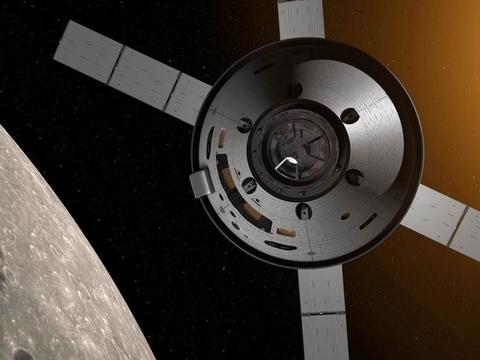
Space exploration
Airbus is at the heart of space exploration, designing and delivering innovative spacecraft, robots, scientific experiments…


The latest Space news
In the spotlight
-

Airbus delivers first batch of next-generation satellites for Eutelsat’s OneWeb…
Press Release
Space
Airbus delivers first batch of next-generation satellites for Eutelsat’s OneWeb constellation. Read more. -

Eutelsat orders 229 additional OneWeb satellites from Airbus
Press Release
Space
-

Artemis II crew touches down at Airbus in Bremen to celebrate a flawless flight
Web Story
Space
-

From cleanrooms to orbit: How Airbus is building end-to-end space sustainability
Web Story
Space
-

Artemis II: Why we are going back to the Moon and why it matters
Web Story
Space
