
Artemis II: Why we are going back to the Moon and why it matters

In just a few weeks, NASA’s Artemis programme will make history with the first crewed flight to the Moon in more than half a century, taking off from Kennedy Space Center, Florida. Four astronauts will embark on a 10-day mission around the Moon aboard the Orion spacecraft, powered by the European Service Module (ESM), developed and manufactured by Airbus on behalf of the European Space Agency (ESA).
Artemis II is a pivotal milestone: demonstrating Orion's vital life-support systems, as well as navigation and communications - this time with astronauts onboard - paving the way for humankind’s return to the lunar surface.
The thirst for discovery
Faced with Earth’s pressing challenges - climate change, poverty, and geopolitics - the question of why we are going back to the Moon is a legitimate one. Yet, exploration is an inherent part of human nature. From the first navigators to contemporary explorers, the unknown has always driven us to surpass our limits, to discover uncharted territories or explore the depths of our oceans. Today, space is our new frontier.
The Artemis programme has an ambitious goal: to establish a sustained long-term human presence on the Moon, using it as a stepping stone to even more distant destinations, such as Mars.
A technological laboratory
The lunar environment is hostile: a vacuum with no atmosphere, cosmic radiation, no protection from meteoroids, extreme temperatures, and very low gravity that puts the human body to the test. These constraints demand specific research in fields such as medicine, robotics, energy, and materials science.
History has shown us that major space projects are a catalyst for technological progress with beneficial returns on Earth. For instance, the Apollo missions led to significant advances in computing and mobile technology. The permanent presence of astronauts on the International Space Station (ISS) has led to innovations on Earth in recycling, water purification, food preservation, and vertical farming.
The research developed today leading to new technologies and innovations will have an impact on our lives in the future.
Living off the land: from lunar dust to life support
For humans to survive on the Moon, they need to be able to breathe, drink, eat, and have an energy supply. On the Moon, every resource counts. The presence of water ice is fundamental, but the lack of air will require the development of specific solutions. Today on the ISS, 45% of oxygen is recycled and more than 90% of water; but much more will be needed for lunar habitats, with the aim of being as self-sufficient as possible in situ.

© ESA/Data from Paige et al., Science - Confirmation of Moon water
© ESA/Data from Paige et al., Science - Confirmation of Moon water
Lunar dust, known as regolith, could be used to build habitats, produce oxygen and fuel and even extract metals (such as aluminium, silicon and iron) for infrastructure. When it comes to food, the ability to produce food in-situ will be crucial to reduce cargo shipments. Studies are underway on resistant plants capable of growing in lunar conditions.
The extreme constraints of the Moon act as a catalyst for Earth-bound innovation. On the lunar surface, zero waste is not a goal, it is a survival requirement. The systems we develop to reach this autonomy could accelerate our transition to a circular economy on Earth, from domestic water recycling to creating new, low-impact materials that could transform the way we build and power our homes or manage recycling.

Lunar base made with 3D printing
The Moon: A treasure trove of science
The Moon is a ‘guardian’ of our solar system's history. Born of a giant collision with Earth billions of years ago, its surface has remained unchanged. Studying it means learning more about the creation of the solar system and understanding how life appeared on Earth, where we come from. This research could even help determine if planets such as Venus and Mars were once habitable.
Artemis II will take astronauts closer to the Moon than any human has been in over fifty years - and further from Earth than ever before. The scientific research conducted during this mission will form the foundation for future crewed spaceflights, with information collected on the effect of space travel on the human body and how it behaves, as well as on radiation.

© NASA - Shadow of the Apollo 11 Lunar module silhouetted against the Moon's surface
© NASA - Shadow of the Apollo 11 Lunar module silhouetted against the Moon's surface
As we prepare for the return to the lunar surface, Europe is not merely following a path; it is helping to pave the way for future generations.
By proving that the impossible is within our reach, we ignite a spark of inspiration that encourages tomorrow’s pioneers to embrace dreams that transcend the individual, moving us all to go further together than we ever could alone.

Follow the Artemis II mission with Airbus
Orion spacecraft set to embark on historic crewed lunar flyby
You might also be interested in
-
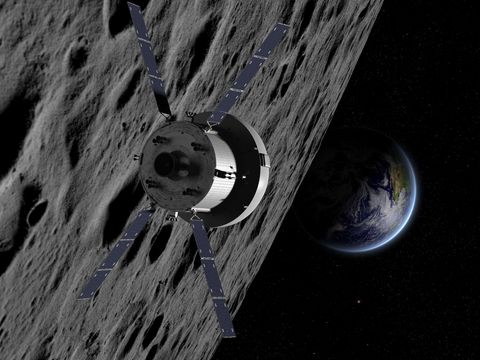
Orion European Service Module
NASA’s Orion will take humans back to the Moon. Airbus-built European Service Module provides propulsion, power, water and oxygen…
-

Moon missions
Our lunar mission solutions will enable humans to return to the Moon and establish a permanent presence on the lunar surface.
-
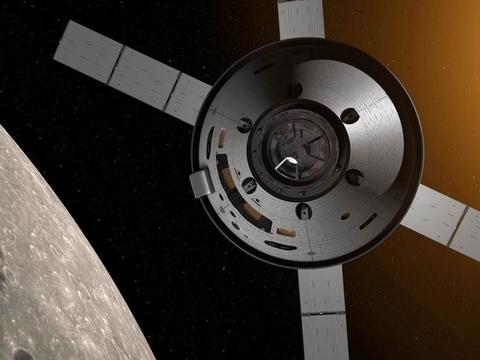
Space exploration
Airbus is at the heart of space exploration, designing and delivering innovative spacecraft, robots, scientific experiments…


Space Latest News
Continue Reading
-

Airbus delivers first batch of next-generation satellites for Eutelsat’s OneWeb…
Press Release
Space
Airbus delivers first batch of next-generation satellites for Eutelsat’s OneWeb constellation. Read more. -

Eutelsat orders 229 additional OneWeb satellites from Airbus
Press Release
Space
-

Artemis II crew touches down at Airbus in Bremen to celebrate a flawless flight
Web Story
Space
-

From cleanrooms to orbit: How Airbus is building end-to-end space sustainability
Web Story
Space
-

Artemis II: Why we are going back to the Moon and why it matters
Web Story
Space
