
UH-72 Lakota

Unmatched versatility
Derived from the Airbus H145 family of helicopters, the UH-72 Lakota is a highly versatile and reconfigurable aircraft that can be tailored for a range of operations across a variety of conditions and environments.
The aircraft is manufactured in the US, with two variants currently performing missions for the U.S. Army and U.S. Navy: the UH-72A and UH-72B.
With over 480 helicopters in service representing the U.S. Army's third-largest rotorcraft fleet, the Lakota has accumulated over 1.6 million flight hours across Army, National Guard, and U.S. Navy operations.


Hoist operation with Airbus UH-72B Lakota
UH-72B Lakota
Enhancing operations across the nation
The UH-72 Lakota’s missions are as varied as its operating locations, and include training, search and rescue, reconnaissance, MEDEVAC, disaster response, firefighting, homeland defense, drug interdiction, command and control and VIP transport.
The UH-72 Lakota represents the third largest fleet in the U.S. Army and supports the Army and Army National Guard units across 49 U.S. states and territories. The aircraft recently surpassed 1.6 million flight hours across its Army, National Guard and U.S. Navy fleets.


Lakota in flight
Lakota in flight
Ready on arrival
As a commercial off-the-shelf (COTS) program, the UH-72 Lakota platform delivers the advantages of proven production, commercial program improvements, sustained engineering, and capability growth without cost burdens associated with research, development and testing.
Incorporation of COTS technologies, combined with the UH-72's operational ability, result in an aircraft that is reliable, flexible and affordable to operate and maintain.
UH-72A
The UH-72A Lakota is a versatile, twin-engine light utility helicopter developed by Airbus Helicopters and used by the U.S. Army, U.S. Army National Guard and U.S. Navy. The UH-72A offers a combination of advanced avionics, a spacious cabin and impressive payload capacity making it an ideal platform for both military and civilian operations.


uh-72a trainer 2008
The U.S. military’s training partner
UH-72A
In 2015 the U.S. Army re-purposed the UH-72A Lakota to support and sustain the Initial Entry Rotary Wing – Training (IERW-T) mission at Fort Rucker. This role ensures all new U.S. Army Aviators receive initial rotary wing training, instrument procedures, warfighter skills, and emergency procedures prior to transitioning to their advanced aircraft. A twin-engine aircraft, the Lakota can function in modes that closely represent the flight characteristics of the ‘go-to-war’ aircraft the graduate IERW student will operate.
Since becoming the primary trainer for the U.S. Army Aviation School’s training mission in 2020, the Lakota trains around 1,400 students annually and flies in excess of 125,000 flight hours. To date, the Lakota has trained more than 8,000 students and accumulated over 800,000 flight hours.
The U.S. Army’s Combat Training Centers also employ the UH-72A as observer and controller and opposing force aircraft in support of their realistic combat and threat training scenarios for Joint and Combined Arms Forces.
The Army rotates more than 140,000 soldiers annually through its Combat Training Centers (CTCs). The CTCs are located at the National Training Center, Fort Irwin, CA; the Joint Readiness Training Center at Fort Johnson, LA and the Joint Multinational Readiness Center at Hohenfels, Germany. The CTCs are renowned for providing leaders at all levels effective training and skills to successfully fight and win our Nation’s wars.
In addition to the Army, the U.S. Navy Test Pilot School operates the UH-72A Lakota as its primary trainer for experimental and developmental flight test training at Naval Air Station Patuxent River, Maryland. Approximately 24 test pilots are trained annually to perform acquisition testing of future aircraft to meet the Navy’s operational needs.
The UH-72A Lakota's Advanced Automatic Flight Control System
The UH-72A Lakota’s advanced flight control system (AFCS) provides five stabilization modes, from manual to full automation. This versatility builds a strong pilot foundation in a safe, twin-engine environment. With over 800,000 training hours at Fort Novosel and a perfect safety record of zero fatal mishaps, the Lakota prepares U.S. Army students for successful careers through elite technology.
250703_Lakota_SAS-V8_A2
UH-72B
The UH-72B Lakota, the latest addition to the successful UH-72 family, represents a significant advancement in rotary-wing technology.
Delivered to the U.S. Army in September 2021, the UH-72B incorporates numerous enhancements derived from the commercial aircraft's lifecycle, including improved power, controls, avionics, and safety features – all achieved at no additional cost to the government.
Key enhancements include a five-bladed main rotor (compared to the UH-72A's four-bladed system), Fenestron shrouded tail rotor, upgraded Arriel 2E engines with dual FADEC, and the Helionix avionics suite with four-axis autopilot enabling automated takeoffs.
These enhancements position the UH-72B Lakota as a versatile and efficient asset for the U.S. Army, offering improved performance, safety, and operational capabilities.
Key technological advancements
Fenestron Shrouded tail rotor
A redesigned gearbox reduces maintenance and enhances ground safety, while the new bearingless, five-bladed rotor increases load capacity and reduces maintenance costs.

Enhanced power and controls
An upgraded Arriel 2E power plant and dual FADEC provide more power and improved controllability. The four-axis autopilot enables automated takeoffs and enhances overall flight control.

Advanced avionics
The Airbus Helionix avionics suite offers a cutting-edge human-machine interface, improving situational awareness and reducing pilot workload. The four-axis autopilot further streamlines flight operations and enables automated controllability.


Did you know?
The Lakota aircraft is built and delivered from Columbus, Mississippi by a workforce of nearly 250 employees, nearly 30% of whom are veterans.

Get in touch
Contact our Lakota support team for additional information and assistance.
Frequently asked questions (FAQ)
UH-72 Lakota
What is the UH-72 Lakota used for?
The UH-72 Lakota serves three primary roles: training, homeland security, and disaster response. Since 2020, the Lakota has been the U.S. Army's primary training helicopter at Fort Novosel, training approximately 1,400 aviators annually with zero fatal mishaps in over 800,000 training flight hours, the safest training helicopter in Fort Novosel's history. For Army National Guard units across 49 U.S. states and territories, the Lakota performs homeland defense missions including border security, drug interdiction, search and rescue, and MEDEVAC operations.
How many UH-72 Lakota helicopters does the U.S. Army have?
The U.S. Army operates 479 UH-72 Lakota helicopters, making it the service's third-largest rotorcraft fleet. The fleet serves Army and Army National Guard units across 49 U.S. states and territories. Since first delivery in December 2006, Airbus has delivered 480+ Lakota helicopters on time and on budget, representing a $4 billion+ Army investment.
Where is the UH-72 Lakota manufactured?
The UH-72 Lakota is manufactured in Columbus, Mississippi, at the Airbus Helicopters facility by a workforce of approximately 250 employees, 30% of whom are military veterans.
What kind of missions does the UH-72 perform?
The Lakota performs homeland security, training, disaster response, and medical evacuation missions within the United States and its territories. The Lakota's reliability is proven through demanding operations including 24 National Guard helicopters flying 14,000 hours on the Southwest border in 2023.
What is the UH-72 Lakota's passenger capacity?
The UH-72 Lakota can transport eight passengers in its utility configuration, or two litters (stretchers) plus medical crew in the MEDEVAC role. The spacious cabin accommodates a crew of two pilots plus the mission-specific load. Large clamshell doors at the rear and side-mounted access doors enable rapid loading even with rotors turning. The flexible cabin allows reconfiguration between passenger transport, medical evacuation, cargo operations, and other missions across the platform's 49-state operational footprint.

Explore the Airbus U.S. helicopter fleet
From the UH-72 Lakota to the MQ-72C Connector, discover the future of U.S. military vertical lift missions.
The latest on the UH-72 Lakota
in the spotlight
-

The Lakota: the all in one UAS
Web Story
Helicopters
The possibilities UAS bring to vertical lift operations is generating interest. The USMC is convinced, asking to develop an unmanned variant of the UH-72 L -

Hurricane Helene relief efforts show the UH-72B Lakota is a force for good
Web Story
Helicopters
-
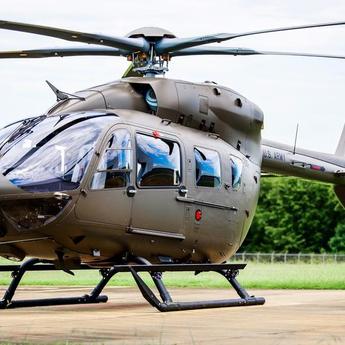
U.S. Army National Guard to operate first UH-72B in Arizona
Press Release
Helicopters
-
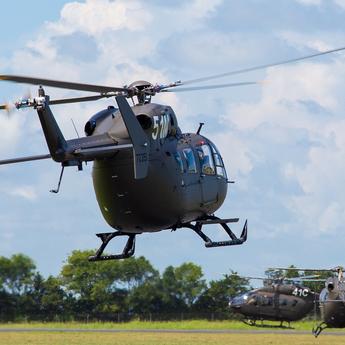
Airbus delivers U.S. Army Aviation Center of Excellence's 20th UH-72A Lakota
Press Release
Helicopters


Topics in focus
-
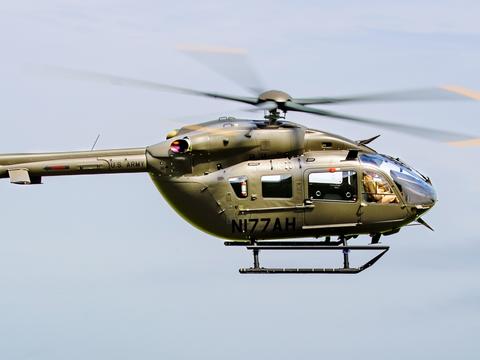
UH-72 Missions
Military Services rely on the UH-72A Lakota’s versatility in multiple configurations to accomplish missions.
-

H145M
The twin-engine H145M provides the capability of transporting troops and materiel with minimal delay and delivering rapid…
-

H145M missions
Airbus’ modern and versatile H145M military helicopter offers a wide range of tactical operations for battlefield roles.
-
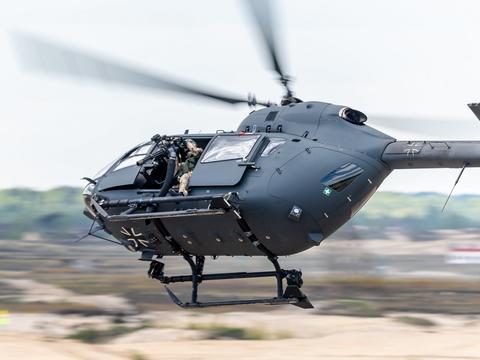
H145M technical information
Airbus’ modern and versatile H145M military helicopter offers a wide range of tactical operations for battlefield roles.
-
Military helicopters
With some 19,000 helicopters delivered in 150 countries, Airbus Helicopters supplies almost one-third of the world’s rotorcraft…


