
MARS Autonomy
The mission and flight autonomy and teaming intelligence solution for crewed and uncrewed assets

Autonomy meets intelligent teamwork
Airbus pioneers advanced collaborative systems, combining air power, space systems, secure communications and cyber resilience. As a leading systems integrator, we foster a robust European defence aerospace ecosystem. We design connected solutions and enable seamless teaming with and among Uncrewed Aerial Systems (UAS) to advance complex multi-domain operations.
Our unique technological expertise enables us to deliver new mission capabilities to our customers. MARS Autonomy is our innovative software solution that enables both crewed and uncrewed systems - individually, or in homogeneous and heterogeneous groups across any domain - to autonomously and collaboratively execute missions.
The teaming intelligence software significantly accelerates the OODA (Observe, Orient, Decide, Act) loop. With limited pilot or operator involvement, it delivers improved common situational awareness, increased survivability in contested environments and enhances combat mass.
Networked autonomy for Crewed-Uncrewed, Uncrewed-Uncrewed Teaming
MARS Autonomy enables assets to operate in concert towards a shared mission objective. Uncrewed systems, connected by distributed intelligence, serve as powerful force multipliers and operational support for crewed aircraft. This teaming enhances collective capabilities, protects the pilot and reduces cognitive burden.
MARS Autonomy also enables purely uncrewed assets to collaboratively perform missions under human oversight.

Eurofighter with 2 XQ-58 over baltic maritime environment
Flexible, open and extensible system architecture
Airbus works with partner companies to integrate mission autonomy capabilities into the wider UAS ecosystem. Our solution is built upon a platform-agnostic system architecture, and our ambition is to set an interoperability standard in Europe.
The MARS Autonomy software offers generic interfaces for various mission support software elements, including third-party data processing subcomponents such as Automatic Target Recognition (ATR) or other AI applications.
Expanding interoperability with MARS Autonomy
Proven mission autonomy and AI-assisted automatic target recognition with strategic tactical UAV partners
Airbus demonstrated with Primoco UAV the autonomous management of a multi-role team of UAVs, proving successful integration with 3rd party systems and mission capability-extending software components.

Demonstrated in Europe’s first large-scale multi-domain crewed-uncrewed teaming flight demo
Airbus demonstrated crewed-uncrewed teaming capabilities with 10 connected assets—fighter jets, a helicopter, uncrewed remote carriers (Do-DT25)—in a real-life, near-operational scenario.

Shaping the future of collaborative combat in Europe
In the partnership with Kratos, the XQ-58A Valkyrie will be equipped with an Airbus mission system to deliver a flight-proven Uncrewed Collaborative Combat Aircraft (UCCA) that will team with fighter jets.


AIRBUS COLLABORATION DEMO PISEK CZ 2024
Scalable for multi-domain applications
Beyond teaming between fighter jets and Uncrewed Collaborative Combat Aircraft (UCCA), MARS Autonomy is designed to enable mission autonomy where scalability across domains is critical.
It supports a range of missions:
- Automated persistent wide area surveillance
- Suppression of Enemy Air Defence (SEAD) / Destruction of Enemy Air Defence (DEAD) operations
- Collaborative combat and attack
- Precision strike
- Communications relay
- Autonomous cargo logistics for troop supply
- Convoy protection
Video Gallery
-
 Airbus Primoco Demo Mission
Autonomous Operations: Collaborative Surveillance powered by MARS Autonomy, in Partnership with Primoco UAV (ILA 2026).
-
 MARS Autonomy
-
 Future Combat Air Systems - from vision to reality
Future Combat Air Systems - from vision to reality

Technical information
Discover our latest brochures
MARS Family
MARS Autonomy focuses on curated cluster of capability applications from the MARS family that we actively scale and promote to the wider Airbus and non-Airbus UAS ecosystem. If you are looking for our Multiplatform, Reconfigurable, Secure Mission System solution, explore the MARS Mission System page.


Frequently asked questions
Airbus MARS Autonomy
What is MARS Autonomy?
MARS Autonomy is an AI-enhanced software solution developed by Airbus. It provides the intelligence for uncrewed aerial systems (UAS) to carry out their missions autonomously. Furthermore, MARS Autonomy enables platforms to collaborate seamlessly during a mission, whether that be different UAS working together (uncrewed-uncrewed teaming) or UAS joining forces with crewed aircraft (crewed-uncrewed teaming). This collaborative approach enhances collective capabilities during critical military operations, improves the safety of pilots and crews, and reduces the cognitive burden on humans.
What does ‘teaming’ mean?
Teaming means that platforms — whether crewed or uncrewed — work together to achieve a shared mission objective. The composition of these teams is variable, for example, several uncrewed systems can collaborate autonomously to achieve their objective.
A central concept in this context is crewed-uncrewed teaming. The crewed aircraft acts as the command node, while the uncrewed assets provide support or serve as force multipliers. This effectively turns the pilots into conductors, directing the uncrewed platforms to carry out specific tasks, such as engaging targets or jamming air defence systems.
What are the benefits of crewed-uncrewed teaming?
Crewed-uncrewed teaming expands the tactical options during military operations. Uncrewed platforms can operate in contested airspace and fulfil their missions largely autonomously. This contributes to the safety of pilots and crews, as they don’t have to put themselves in harm's way.
At the same time, crewed-uncrewed teaming reduces the cognitive load placed on pilots and crew members. In modern military operations, they must process large amounts of information and perform a variety of tasks simultaneously, always having to make the best possible decision. Uncrewed platforms can reduce this burden by carrying out their mission autonomously once they have been assigned a task.
What does UAS stand for?
UAS stands for 'uncrewed aerial systems', which are also commonly known as drones. They support a variety of military, government, public service and commercial operations, engaging in missions such as combat, reconnaissance, communications, training and logistics.
What is a UCCA?
UCCA stands for 'uncrewed collaborative combat aircraft'. It refers to a class of high-performance military uncrewed aerial systems designed to operate alone or alongside crewed fighter jets. They carry out missions largely autonomously after receiving orders from a pilot or ground station operator, who supervises the UCCA during operations. UCCAs are designed to carry out high-risk missions in contested airspace, such as deep strikes and electronic jamming. Thus, they provide affordable combat mass and contribute to the safety of crewed fighter jets.
To develop its UCCA portfolio, Airbus has adopted a phased approach. Airbus is currently preparing the U740 Valkyrie to deliver an operational capability by 2029 combining the proven Kratos XQ-58A airframe with Airbus' MARS mission system. This will be followed by the U760 Ravenstorm in the early 2030s. This UCCA will feature an internal payload capacity exceeding 500 kg for air-to-air, air-to-ground, and electronic warfare missions
You will find even more information in our dedicated UCCA FAQ.
What is the difference between MARS Autonomy and the MARS mission system?
MARS Autonomy is a bundle of software applications (cApps) that enables flight and mission autonomy, as well as teaming intelligence. It allows uncrewed platforms to carry out their missions independently and facilitates collaboration between crewed and uncrewed systems towards a shared mission objective. A key part of the Multiplatform Autonomous Reconfigurable and Secure (MARS) Mission System, it is Airbus’ offering of a teaming and autonomy cAPP suite. Nevertheless, MARS Autonomy is system-agnostic and can be integrated into any crewed or uncrewed aircraft.
The Airbus MARS Mission System is an extensive software suite including an operating system and state-of-the-art middleware hosting different capability applications, that will enable future multi-domain operations. Based on open architecture principles, the MARS Mission System unites various platforms and systems under one umbrella. Customers can integrate a variety of applications into it, giving them the flexibility to customise their assets' capabilities exactly as required by the mission. As a European mission system, MARS ensures full operational sovereignty and flexibility for its users.
Has MARS Autonomy been tested in real-world flight demonstrations?
Yes, since 2017, Airbus has been demonstrating the autonomy and teaming capabilities of MARS Autonomy components. Highlights include a multi-domain functional demo in Finland in 2022 inspired by a real-life scenario using up to 10 Airbus platforms (Do-DT25, GFD Learjets, H145). In 2024, an ISR teaming flight test campaign in the Czech Republic also demonstrated compatibility with 3rd party platforms (Primoco One 150) and applications (3rd party AI ATR).
Airbus further demonstrated the capabilities of MARS Autonomy at the 2026 ILA Berlin Air Show, where two Primoco uncrewed aerial systems (UAS) conducted live autonomous missions in the skies above. MARS Autonomy served as the software backbone that enabled the UAS to operate and collaborate autonomously towards the mission objective. It was the first time a collaborative autonomous flight of uncrewed assets had been performed live at a major public trade show in Europe.
You might also be interested in
-

Uncrewed Aerial Systems
Airbus UAS: Explore advanced uncrewed aerial systems for military, government and commercial missions, including combat, ISR, and…
-
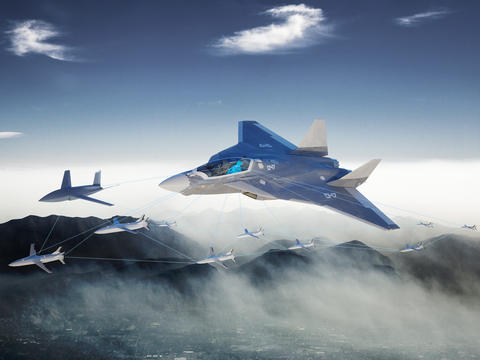
Crewed-Uncrewed Teaming
Airbus is pioneering collaborative combat by developing seamless, intelligent collaboration between manned and unmanned platforms.
-

MARS Mission System
The Airbus Multiplatform Autonomous Reconfigurable and Secure (MARS) Mission System is a Door-Opener for FCAS.


