
Airbus A350 Family, long range widebody aircraft
The shape of efficiency. A new standard in comfort.

Redefining the long-haul experience
THE FUTURE OF FLIGHT
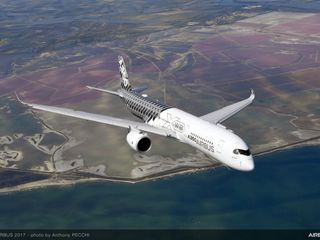
The Airbus A350 was engineered to deliver a step-change in efficiency for long-haul travel, driven by a design focused on state-of-the-art technology.
With over 70% of its airframe made from advanced materials like composites, combined with advanced aerodynamics and new-generation engines, the A350 achieves a significant reduction in fuel burn and emissions.
This advanced design also creates a new standard of comfort and well-being for passengers. This means a journey with wider seats, more natural light, and latest-generation air systems that enhance the sense of space and freshness.
-

-

A350, the longe range leader
The Airbus A350 family represents the pinnacle of modern aviation, offering a complete new-generation solution at the top of the market. Comprised of the A350-900, A350-1000, and the A350F, this family is designed to meet the diverse needs of airlines worldwide. With similar range capabilities between the -900 and -1000 models, airlines can achieve maximum network flexibility, optimising route planning and operational efficiency.
-


Family Days 2024
That's what nearly 15,000 Airbus employees experienced on Sunday 15 September with their children and/or spouses and friends, on their way to the family day organised at the Commercial Aircraft sites in Toulouse. Around 50,000 people visited the emblematic sites of our industrial sites: assembly lines for the ATR, A320/A321, A330 and A350, a static display of all our aircraft, the BelugaXL hall, the undisputed star of the day, Saint Eloi, the Henri Ziegler delivery centre, and the Blagnac site, Campuses 1, 2 and 3.


Paris Airshow 2023 - A350-900 on static
The A350 Family story
A VISION REALISED
Redefining long-haul travel, the A350 is the result of a vision to create the future of air transport. Officially launched in 2006, the programme was a clean-sheet design from the start, focused on creating a step-change in efficiency and passenger comfort through state-of-the-art technology.
- The A350-900: After its first flight in 2013, the A350-900 entered commercial service in early 2015, establishing a new benchmark for long-range, twin-engine aircraft.
- The A350-1000: The longer-fuselage version followed, entering service in 2018 to offer airlines additional capacity for their busiest long-haul routes.
Today, the A350 Family is recognised for its exceptional range, advanced design, and a passenger experience that is shaping the future of intercontinental journeys.

Explore the A350 Family in detail
Discover the technical specifications, performance data and unique capabilities of the A350 Family.
The A350: two sizes for the future of long-haul
CHARACTERISTICS
The A350 Family offers two versions that share a common pilot qualification, enhancing operational flexibility for airlines.
Both variants leverage an airframe made of over 70% of advanced materials and new-generation engines to reduce fuel burn and CO₂ emissions by 25% compared to previous-generation aircraft.
See full dimensions & technical data
* 9/10 abreast
** target entry in service 2030


Airspace A350 XWB ambiance
The A350: comfort that goes the distance
INSIDE THE A350
The A350 features the award-winning Airspace cabin, designed to enhance the sense of well-being on long-haul flights. It is the quietest twin-aisle cabin in the skies, with wider seats, high ceilings, and customisable ambient lighting that helps reduce jet lag. The air within the cabin is renewed with HEPA-filtered air every 2-3 minutes, ensuring the highest possible air quality throughout the journey.
The lowest cabin altitude and the optimum temperature reduce fatigue, and low noise levels help passengers arrive feeling refreshed. Whether in economy or premium cabins, the A350 delivers a calm, comfortable journey from take-off to landing.


A350 XWB touchscreen cockpit displays
Airbus has begun delivering A350 XWB aircraft with pioneering new touchscreen cockpit displays
The A350: technology with purpose
INNOVATION
Behind the A350’s performance is a suite of purpose-driven innovations, many introduced for the first time on a commercial widebody. The A350 is Airbus’ first clean-sheet aircraft built around an advanced composite fuselage, adaptive wings, and next-generation flight systems. From the flight deck to the cabin, it’s designed to reduce emissions, boost efficiency, and enhance the flying experience.
Technology & Innovation
Materials: Advanced by design
The A350’s airframe is built from over 70% advanced materials, including:
- 53% Carbon Fibre Reinforced Polymer (CFRP) in the fuselage, wings, and tail
- Titanium components for strength without corrosion
- Aluminium-Lithium (Al-Li) alloys in select structures to reduce weight and improve fatigue resistance
Together, these materials help reduce overall fuel burn and environmental impact, while increasing structural longevity.
Wings: Built to adapt and perform
The A350’s high-aspect-ratio wings are designed for optimal aerodynamic performance.
- Morphing wing surfaces adapt during flight to minimise drag and maximise lift
- Flexible design smooths airflow, improving fuel economy and ride quality
- The wing’s natural laminar flow and advanced high-lift devices contribute to both range and comfort
Every curve of the A350 contributes to performance:
- Refined aerodynamic shaping reduces fuel burn and extends range.
- New wing profiles and advanced control surfaces (flaps, slats, spoilers) help optimise airflow throughout all flight phases.
- Drag is minimised even at ultra-long range cruising altitudes
Cockpit: Pilot-first digital flightdeck
The A350 flightdeck features a clean, digital layout and touchscreen-enabled interfaces, a first for Airbus.
- Common Type Rating with the A350 simplifies pilot training
- Fly-by-wire flight controls allow for smoother handling and increased safety
- Side-stick controls, HUD integration, and intuitive avionics support pilot confidence and cross-fleet flexibility. Learn more about pilot training on Full Flight Simulators.
The A350 is equipped with Integrated Modular Avionics (IMA), enabling aircraft systems to talk to each other in real time.
- IMA supports flight planning, fuel optimisation, and system health monitoring
- Traffic Collision Avoidance System (TCAS) and Enhanced Ground Proximity Warning (EGPWS) increase safety and situational awareness
- Onboard sensors also enable predictive maintenance, improving dispatch reliability
Systems: Passenger-focused performance
The A350’s systems are engineered for efficiency and passenger well-being:
- HEPA filters and complete air renewal every 2 - 3 minutes
- Lower cabin altitude (6,000 ft) and multi-zone temperature control for comfort
- LED lighting that adapts to time zones to help reduce jetlag
Noise-optimised airframe and engine nacelles make the A350 up to 9 decibels quieter than competing aircraft
Discover more about the A350
Short videos
-
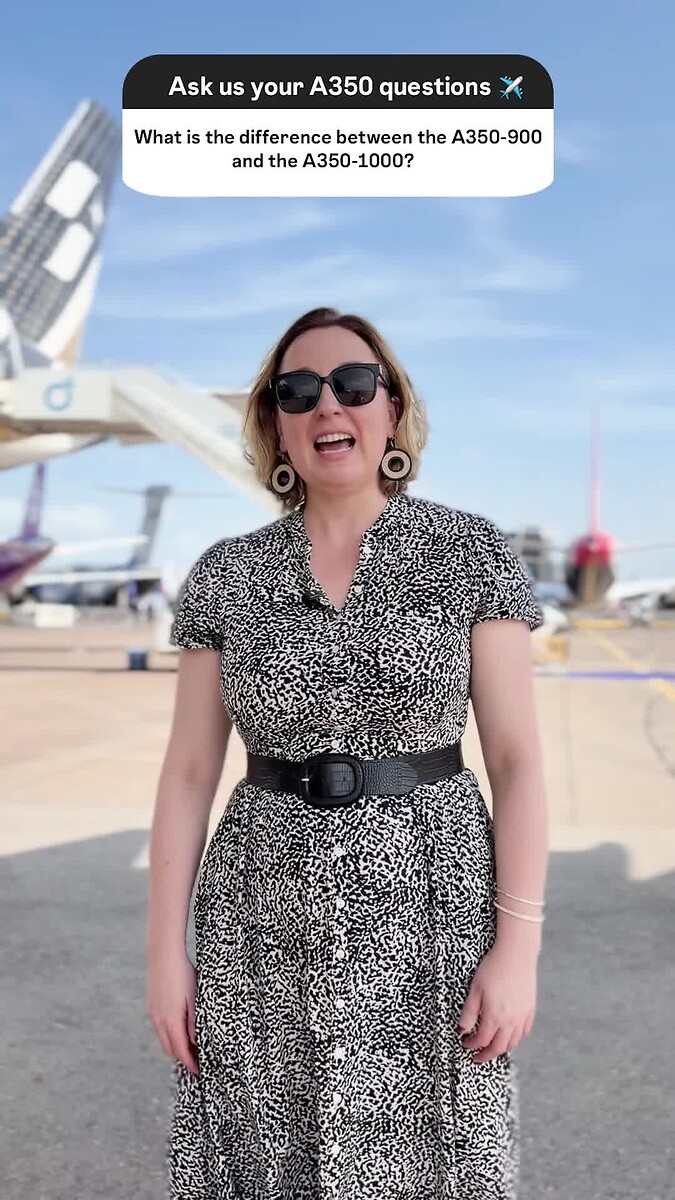 What is the difference between the Airbus A350-900 and the Airbus A350-1000?
What is the difference between the Airbus A350-900 and the Airbus A350-1000?
-
 Why does the Airbus A350 have the black mask around the cockpit?
Why does the Airbus A350 have the black mask around the cockpit?
-
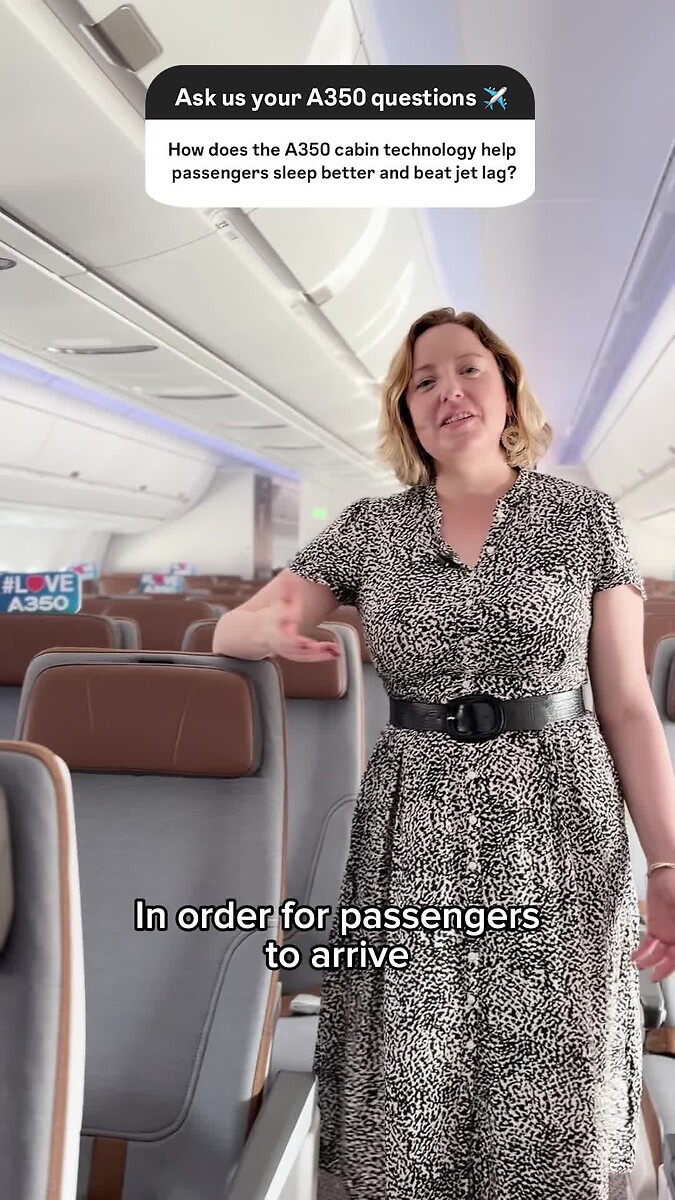 How does the Airbus A350 cabin technology help passenger sleep better and beat jetlag?
How does the Airbus A350 cabin technology help passenger sleep better and beat jetlag?
-
 Is the Airbus A350 the aircraft that's going to fly the longest flight non stop from Sydney to London?
Is the Airbus A350 the aircraft that's going to fly the longest flight non stop from Sydney to London?
-
 Airbus A350 personality in 3 words
Airbus A350 personality in 3 words


Singapore Airshow 2024 Before Opening A350-1000
The Airbus A350-1000 is refuelled with 35% blend of sustainable aviation fuel (SAF) prior to its participation at the 2024 Singapore Airshow’s flying display
A350: built to fly quieter, farther, and more efficiently
The A350 Family is engineered to reduce environmental impact while delivering long range performance. Its clean-sheet design delivers a step-change in performance:
Reduced emissions: The A350's use of lightweight materials, advanced aerodynamics, and new-generation engines results in a 25% reduction in fuel burn and CO₂ emissions compared to previous-generation aircraft. The A350 is certified for the latest ICAO CO₂ emission standards.
We love A350
-


Singapore Airshow Day 1
A350-1000 flying display at Singapore Airshow 2024
Airbus’ decarbonisation strategy for aviation includes the support for increased production, distribution and use of sustainable aviation fuel (SAF), as spotlighted by the Singapore Airshow flight demonstration of its A350-1000 fuelled with an SAF blend -

FAL A350 English Version
This video provides an inside look at the FAL (Final Assembly Line) for the Airbus A350
-


-


-


-


Boarding and bin loading in the A350 Airspace welcome area cabin
Boarding with unique welcome, bin loading
-


A350-1000 Qantas Airbus MSN59 nose close up - Sydney departure
A350-1000 Airbus Qantas MSN59 - arrival at Sydney Airport
A350 Australian demo tour
#LongRangeLeader -

A350 family shaping the future of air travel
The A350 offers the ultimate passenger experience even on the longest of flights. Its innovative design delivers a true feeling of spaciousness, with wide seats, high ceilings and alluring ambient lighting.
-


Singapore Airshow 2024 Before Opening A350-1000
Airbus’ decarbonisation strategy for aviation includes the support for increased production, distribution and use of sustainable aviation fuel (SAF), as spotlighted by the Singapore Airshow flight demonstration of its A350-1000 fuelled with an SAF blend
-


Passengers in 9 abreast seats of A350 Airspace Economy class cabin v1
9 abreast Economy, pax version 1Hero


A350 FAQs
When did A350 enter into service?
The A350-900 entered commercial service in January 2015 with Qatar Airways, followed by the larger A350-1000 in 2018.
Where are A350 made?
Final assembly takes place at Airbus’ facility in Toulouse, France. However, the manufacturing of A350 components is a global effort.
Major structural parts are produced at Airbus sites across Europe:
- Wings are built in Broughton, UK,
- Fuselage sections are manufactured in Hamburg, Germany, and Saint-Nazaire, France,
- Horizontal tailplanes are produced in Spain,
- Key systems and components also come from a wide network of suppliers around the world.
This global industrial model enables Airbus to combine regional expertise with world-class precision, ensuring every A350 meets the highest standards of quality, safety, and performance.
How many seats does an airbus A350 have?
The A350-900 typically seats 300–350 passengers in a standard 3-class layout, while the A350-1000 accommodates 350–400. In high-density configurations, the A350 can seat up to 480 passengers.
How big is the Airbus A350?
The A350-900 is 66.8 metres long, while the A350-1000 stretches to 73.8 metres. Both variants share a wingspan of 64.75 metres and stand just over 17 metres tall.
How far can an Airbus A350 fly?
- The A350-900 designed to fly up to 8,600 nm (~15,750 km)
- The A350-1000 designed to fly up to 9,100 nm* (~16,850 km) (*target entry in service 2030)
- The A350-900ULR can fly up to 9,800 nm (~18,000 km) which is equivalent to 19+ hours in the air, making it the world’s longest-range airliner.
Where does the A350 fly?
The A350 operates on more than 1,500 global routes, including:
- Ultra long-haul: Singapore – New York, Doha – Auckland, Perth – London
- Transatlantic: Paris – Miami, London – Los Angeles
- Regional & high-density routes in Asia, Europe, and the Middle East
With its range and efficiency, it’s a favorite for airlines operating long-haul and ultra-long-haul flights.
What engines are on the A350?
Every A350 is powered by Rolls-Royce Trent XWB engines, among the world’s most efficient large turbofans, and the world’s most efficient large aero engine flying today
- A350-900: Trent XWB-84 (84,000 lbs of thrust)
- A350-1000: Trent XWB-97 (97,000 lbs of thrust)
What is the difference between A350-900 and A350-1000?
The A350-1000 is a longer, higher-capacity version of the A350-900, with more powerful engines, extended range, greater premium cabin space, and higher maximum takeoff weight. Both offer outstanding efficiency, comfort, and global reach.
Discover more about A350
-

Biman Bangladesh Airlines places firm order for A350-900 and A321neo Airbus aircraft
Press Release
Commercial Aircraft
Biman Bangladesh Airlines places firm order for A350-900 and A321neo Airbus aircraft. Lear more about it. -

KLM Royal Dutch Airlines takes delivery of its first Airbus A350-900
Press Release
Commercial Aircraft
-

Countdown to A350F first flight: Preparing for the sky
Web Story
Commercial Aircraft
-

Unpacking the A350F’s new livery
Web Story
Commercial Aircraft
-

Extending the horizon: Inside the A350-1000ULR’s longest development flight
Web Story
Commercial Aircraft

You might also be interested in
Discover more
-
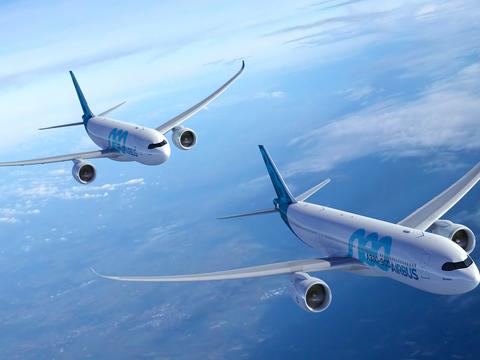
Airbus A330 Family, versatile widebody aircraft
Discover the A330 Family, a versatile widebody valued for its proven performance. Explore the modern A330neo and its award…
-

Airbus A320 Family, the most delivered aircraft ever
Flown by 300+ operators, the A320 Family is an icon of innovation. Discover its fly-by-wire cockpit, spacious Airspace cabin, and…
-

Airbus A220 Family, purpose-built single-aisle aircraft
Discover the Airbus A220: a clean-sheet design single-aisle aircraft offering quiet comfort, fuel efficiency, and unmatched…
-
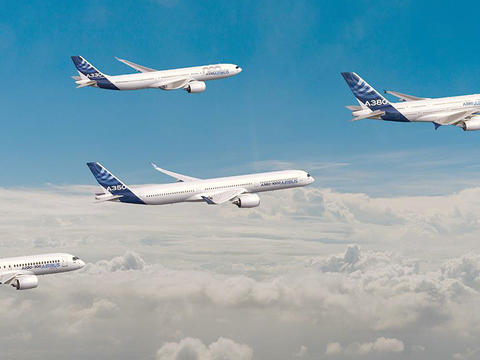
Airbus Passenger Aircraft
Explore Airbus passenger aircraft. Discover comfortable, safe & efficient flight with our A220, A320, A330, A350 & A380 families…


