
AI agents: A new paradigm of military decision-making

In today's operations, commanders must make quick tactical decisions based on a wealth of information. AI agents can greatly simplify this process. Learn how Airbus aims to synchronise and coordinate their collaboration via a framework for agentic AI.
In modern conflicts, military commanders face a paradoxical challenge: From real-time drone feeds to global intelligence reports, they have more information at their disposal than ever before, yet this sheer volume threatens to hinder them. When thousands of data points must be converted into tactical decisions, every second counts. "At its core, warfare is about achieving decision superiority — making well-informed choices faster than the adversary," says Jonathan Debure, Head of Strategy and Technical Intelligence at Airbus Defence and Space.
Lending a helping hand: Large language models
This is where large language models (LLMs) provide a significant operational advantage. Ever since the hype surrounding generative AI picked up in 2022, it has also become a key area of interest for the armed forces. “Based on tactical insights, LLMs can provide decision-makers with well-founded recommendations in a very short time,” says Debure. How so? The tactical decision-making process consists of various tasks that LLMs excel at, such as gathering, aggregating, summarising and prioritising information. They can perform all of this faster than a human ever could.
Furthermore, LLMs simplify the workflow, making it more user-friendly and intuitive. Creating a situation report or launching a complex simulation now only requires a natural language command.

With its framework for agentic AI, Airbus brings together various data points and agents under one roof.
The next frontier: AI agents
LLMs have been widely adopted in recent years. And while we at Airbus have been developing and testing them for use in military decision-making processes alongside the armed forces, another topic of interest has emerged: AI agents. Unlike standard LLMs, which primarily process and generate text, agents are defined by their ability to execute a sequence of actions to achieve a specific goal. "Modularity is the magic word," says Debure. "Rather than one system trying to do everything, we break down a complex task into smaller elements that can be handled by a specialised AI agent. By bringing multiple agents together, we can then automate incredibly complex operational sequences."
The ultimate goal is to create an 'AI agent mesh'. This concept describes a web of interconnected agents operating simultaneously across every level of the armed forces, from the handheld devices of soldiers on the front line to the computers in regional headquarters. Debure outlines the vision: "Commanders won't need to be experts in the underlying simulation software or the battle management system. They simply enter a task in their own words, and the agents collaborate behind the scenes across various platforms to deliver a result.”
Agentic AI: The framework from Airbus
If each agent specialises in a particular task, then there needs to be a framework to define how they all work together. Airbus is developing this very thing right now. Debure, who leads its technical implementation, explains: “With our framework, we bring the logic behind agentic AI to life. It is all about independently recognising which specific combination of agents is required to solve a complex tactical problem in real time." The aim of defining such a framework is to address two common challenges associated with agentic AI solutions: prevent hallucinations and provide traceability.

Infographic
Overall, this approach paves the way for a vast 'toolbox' of agents. “Currently, we have defined around 90 specialised agents,” says Debure. These include a data selector, which identifies relevant imagery, sensor data and text, or a tasking agent, which triggers assets like drones or satellites to gather additional information.
The Airbus framework also seeks to present users with information in the most concise and understandable way possible. “It should not just be a plain chat window. We want to provide a map containing all the necessary information,” says Debure. This map will display all the relevant data sources and information, for instance data from aircraft and ships. Based on natural language commands, these data sources will then be linked to each other and highlighted visually.
A future of seamless collaboration
Looking ahead, Debure sees AI as an integral part of the digital infrastructure of our armed forces. “In the near future, interacting with AI agents will be as unremarkable as using a word processor or spreadsheet,” he says. And as specialised agents become more sophisticated, the goal of decision superiority will become an operational standard rather than a technological aspiration. “AI will bolster the military decision-making process by managing the complexity of the modern battlefield, allowing commanders to focus on what matters most: leading the mission to success.”
Discover more
-
Military Aircraft
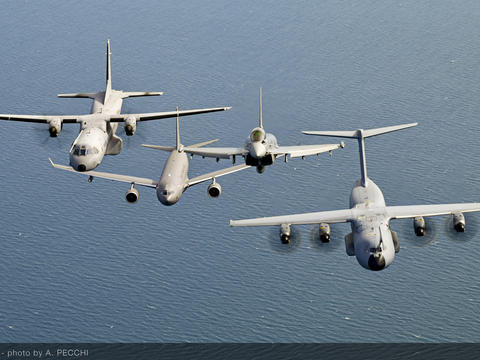
The company’s military aircraft portfolio includes the Eurofighter combat aircraft; the A400M, C295 and CN235 airlifters; and the…
-

Defence and innovation: Why security matters for our future
Defence is the foundation of our freedom. It ensures our security, strengthens the economy and drives innovation. Find out why…


Latest Defence news
Continue Reading
-

Timber Express: Virtual battlespaces as the future of testing and training
Web Story
Defence
Real jets, synthetic threats: Airbus supported the Timber Express exercise of the German Air Force in summer 2026 and trialled a new digital paradigm. -

Airbus networked intelligence: Shaping the future of autonomous UAV missions
Web Story
Defence
-

A400M Atlas: On a mission at the edge of the world
Web Story
Defence
-

Airbus spearheads new E2D European defence tech fund
Press Release
Defence
-

Bird of Prey: the Airbus answer to one-way attack drones
Web Story
Defence
