
Pushing the A350F to the limits: aircraft ground testing gets underway

The introduction of the A350 freighter version (“A350F”) represents a new challenge for Airbus, and the complexity of bringing a new aircraft variant to market is perhaps nowhere more evident than in the ground testing performed during final assembly.
What are the A350F’s innovations for cargo operations?
The A350F has introduced numerous systems which either feature major modifications or are completely new. These are largely concentrated in the cabin and cargo areas and have necessitated the development of associated aircraft ground tests. Key new systems to be tested include:
- main-deck cargo loading system
- main-deck cargo door
- dedicated ‘courier’ area with seating for up to 10 occupants
- anti-tail-tipping warning system
- main-deck drainage system
- new water & waste system
- multi-zonal air distribution system
- oxygen system
- ‘Smart Freighter’ on board connectivity system
- video-monitoring system
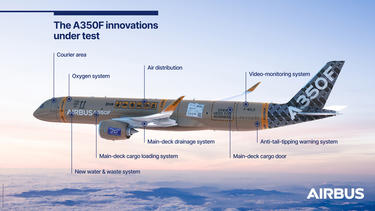
A350F infographic
Guillaume Terrien leads the ground test design activities for the new A350F. “As early as 2021, at the A350F’s definition phase – close collaboration was initiated between the FAL Ground Test Design and Chief Engineering teams,” he recalls. “The goal was to share FAL testability constraints so they could be taken into account from the preliminary aircraft design stage, thus facilitating future ground tests at the FAL stations. This approach is known as ‘co-design’.
Some highlight examples of co-designed ground tests for the A350F include:
- The Cargo Loading System (CLS) comprises hundreds of electrical components on the floor , which requires automated testing of the many interconnecting cables and wires. “To simplify their CLS testing in serial production, Ground Test Design and Engineering devised a solution that allowed automated wiring self-tests to be performed directly from the cockpit using the computer's software functions,” explains Guillaume. “Therefore, as soon as the power-on happens in the A350 final assembly line, self-tests can automatically check more than 1,300 wires. The use of software automation minimises the time taken for the tests to a few minutes.”
- The drainage system: probably the most dramatic ground testing challenge is for the external drainage of water from the cargo holds. The main deck must be able to drain both melted snow and cleaning water to prevent it from stagnating within the structure.

A350F MSN701 water test
“It sounds simple, but it's actually one of the most complex systems,” says Guillaume. “Specific ‘test means’ have been developed to flood the system with more than 180 litres of water to check the tightness and ensure proper evacuation from the 50m long main compartment. The test has to be performed with the aircraft floor in a zero-degree inclination, using specific test means to fill all the pipes,” explains Guillaume.

A350F MSN701 water test
- The Tail Tipping Warning System (TTWS) constantly monitors the nose landing gear compression to prevent the aircraft from tipping onto its tail during loading. To test this system without endangering the aircraft, the teams use specific equipment that ‘tricks’ the sensors by simulating a landing gear extension. The goal is to stop the cargo loading system and validate the immediate triggering of the alarms (audible and visual).
In-production ‘serial ground tests’ vs one-off ‘development & certification tests’
Serial production testing is defined as checking the conformity of the systems' integration compared to the definition of each specific aircraft. The process involves the Engineering team providing requirements for testing, which the FAL (Final Assembly Line) Ground Test Design department transforms into test procedures to be applied by test technicians and the production team. Of the approximately 200 serial ground test instructions (GTI) for an A350 passenger aircraft, as much as 40% have been specifically created or modified for the A350F.
An example of a completely new serial test is the Main Deck Cargo Door Cycling test: The test requires cycling the MDCD many times, both manual, and also electrical to check the system, sensors and alerts behaviour during the FAL cycle.
Another example of a new serial ground test is the innovative Automated Wiring Self-Test for the CLS, described earlier in this article. The CLS will also undergo functional checks in serial production with various ULD containers up to 500 kilograms.
To complement the serial production ground tests, a separate parallel campaign of “development and certification testing” is being performed exclusively on the two flight-test aircraft: MSN 700 and MSN 701. These are one-off performance tests required for validation and verification (V&V) by authorities like EASA. The A350F has 55 such specific tests, known as “Ground Test Requirements”, which are planned and prepared by the FAL Ground Test Design team and executed in conjunction with the Engineering Design Office.
A notable GTR example is the Max Payload Test: This is performed once and involves loading the maximum payload of 111 tonnes – equivalent to the weight of approximately 18 elephants – to ensure correct sequencing and functionality, particularly with the MDCD operation.
The Pressurisation Development Test complements the standard pressurisation test for serial production. For this one-off test,flight test aircraft will be subjected to additional instrumentation, including cameras, displacement sensors, and a microphone on the MDCD, to monitor the door during the cabin pressure cycles.
Summing-up: paving the way for flight tests and service entry
The ground testing of the A350F is a defining phase which ensures that the physical aircraft being completed in the FAL matches the digital design requirements – for both certification as well as during serial production. From the 40% of serial test procedures that were created or re-engineered, to the implementation of 60 specific certification tests, the A350F’s ground testing programme is well on track.
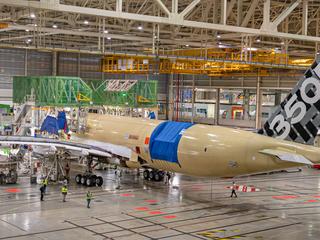
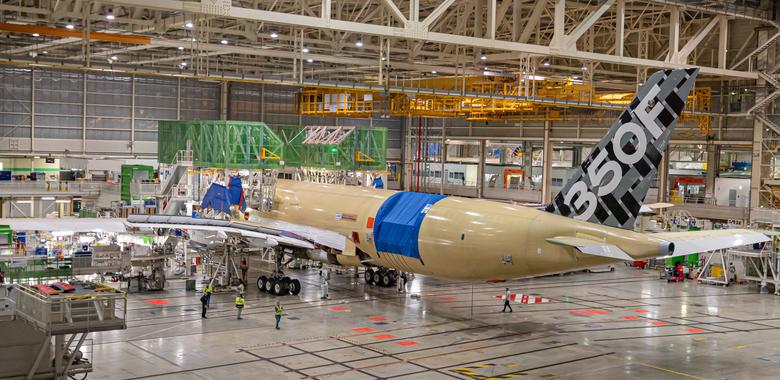
Ground test photos
-
-


A350F MSN701 water test
-


A350F MSN701 water test


Download the A350F ground test infographic
Infographic
A350F infographic ground test
Infographic
A350F infographic ground test
Learn more about the A350F

Read more about the A350F
-

A350F first flight: new freighter aircraft takes to the sky
Web Story
Commercial Aircraft
Read the story about the A350F first flight -

Airbus A350F freighter successfully performs its maiden flight
Press Release
Commercial Aircraft
-

Countdown to A350F first flight: Preparing for the sky
Web Story
Commercial Aircraft
-

Unpacking the A350F’s new livery
Web Story
Commercial Aircraft
-

Pushing the A350F to the limits: Ground Vibration Testing
Web Story
Commercial Aircraft
