
Chasing contrails: How Airbus-backed research is tackling non-CO2 emissions
Exploring the effects of different fuel compositions

ECLIF-X is an Airbus-led flight test campaign at the forefront of researching aviation’s non-CO2 emissions. These emissions include contrails, the white lines behind aircraft at altitude. Contrails are a contributor to aviation’s overall climate impact, as they can trap heat in the atmosphere. ECLIF-X is studying how varying amounts of sulphur in jet fuel affect contrail properties and, more importantly, mitigation.
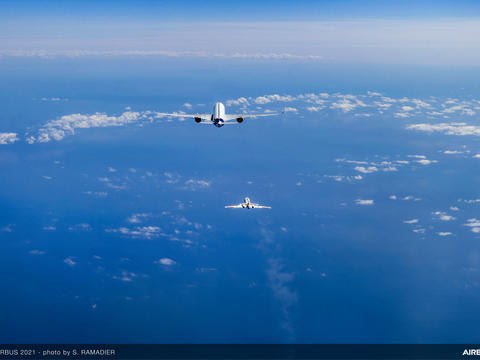
Standing for Emissions and Climate Impact of alternative Fuels, ECLIF-X is an important industry-led R&D project that puts Airbus’ commitment to reducing aviation’s climate impact in the spotlight. The project uses an A321XLR test aircraft flying with three different fuels to understand the effect of fuel composition on engine emissions, and resulting contrail formation and properties.
The ‘X’ in ECLIF-X refers to engine manufacturer Pratt & Whitney’s TALON-X rich-burn combustor, which is designed to reduce gas turbine's soot emissions. These emissions include the small particles or ‘seeds’ involved in the formation of contrail ice crystals. The A321XLR’s Pratt PW1100G-JM engine is equipped with the combustor, and the powerplant’s emissions are the focus of the campaign.
Video courtesy: German Aerospace Center (DLR)
The ‘sticky seed’ problem: soot and sulphur’s role in contrail formation
While CO2 remains the main focus of efforts to lessen aviation’s climate impact, it's not the only piece of the puzzle. In certain conditions, contrails can have a warming effect. They are ice clouds that can form when hot, humid aircraft engine exhaust hits cold, high-altitude air.
When the right combination of atmospheric and exhaust conditions is met, the water vapour emitted by the engines can instantly condense and freeze around the ‘seeds’ found in the exhaust plume. These seeds can be either microscopic soot particles or ‘volatile’ particles, tiny droplets which can form quickly when the engine plume cools down.
Roughly speaking, these particles have two origins: aromatics and sulphur.
Aromatics are compounds in jet fuel that are the primary precursors for soot particles. Sulphur, even in tiny amounts, results in the formation of sulphuric acid. The acid can either form a coating on soot particles that helps water vapour to activate them, or lead to the formation of volatile particles, which can also attract water vapour. These two types of particle can compete and interact during the contrail formation process.

A flying laboratory to stalk emission and contrails
ECLIF-X is a continuation of previous campaigns (ECLIF1-2 and more recently ECLIF3, which was led by Airbus), where the emissions and contrails of other engine types fitted with the rich-burn combustor technology were measured with different fuels, including 100% sustainable aviation fuel (SAF).
ECLIF-X aims to assess the effect of low-sulphur/low-aromatics fuel on the PW1100G-JM engine’s emissions and contrail properties. During the flight test campaign, in-flight emission and contrail measurements are conducted by scientists from the German Aerospace Center (DLR) using a fully instrumented Falcon 20E research aircraft. Drawing on more than 30 years of expertise, the DLR team tracks the A321XLR at distances of 50 to 300 metres to collect precise emissions data.

A closely coordinated chase across the sky
Running from 2025-2027, ECLIF-X involves a carefully choreographed chase across the sky. There are two components:
- The emitter: A321XLR test aircraft MSN11058, flying with three different fuel types.
- The sniffer: Following behind, the DLR Falcon 20E acts as a laboratory in the sky. It flies directly into the A321XLR's exhaust plume to measure emissions and ice crystals.
To get the most comprehensive data, the ECLIF-X team is testing three distinct fuels to cover a wide sulphur range:
- Conventional Jet A-1: The baseline: approx. 200 parts per million (ppm) sulphur, which is below the estimated world fuel sulphur content average of ~500 ppm.
- High-sulphur Jet A-1: A special batch (650 ppm sulphur) to clearly see its impact.
- A very low-sulphur (less than one ppm) and low-aromatic Jet A-1, representing an hydrotreated Jet A-1: To evaluate the maximum potential benefit with this engine type.

Future fuel standards, smarter operations
The data from ECLIF-X is eagerly anticipated. While final results are yet to come (the most recent tests took place in November 2025 and the project has two years left to run), its initial findings are expected to quantify the reduction in soot and ice crystal formation achievable by reducing aromatic and sulphur content in Jet A-1.
The flight test campaign directly supports Airbus' strategy of moving beyond CO2 emissions to address the total climate impact of aviation. ECLIF-X data will help improve understanding of the relationship between fuel composition and engine/combustor design, which in collaboration with DLR will lead to improved modelling and inform work on future fuel standards and design choices.
Moreover, better understanding of when and why contrails form could lead to operational practices including contrail avoidance routing. And ECLIF-X is as much about partnerships with industry and academia as data. Alongside Pratt & Whitney and DLR, the collaboration shows how Airbus is building trusting relationships to solve the complex and shared challenge of non-CO2 emissions.

Airbus NOVA Newsletter
Your go-to source for the latest stories on disruptive technologies and ground-breaking aerospace projects that will transform the way we fly.
Discover more
-
Non-CO2 emissions
Airbus is working with industry partners to better understand and mitigate non-CO2 emissions including contrails.
-

Non-CO2 emissions and contrails, explained
Airbus wants to better understand contrails. These are real, and not to be confused with chemtrails, which are not.
-
How to mitigate contrails and other non-CO₂ emissions
Airbus and aviation industry leaders are working to reduce non-CO₂ emissions, including contrails, through new fuel types and…


The latest in innovation
In the spotlight
-

Airbus kicks off wing facility extension, with major investment into Belfast site
Press Release
Commercial Aircraft
Construction has started on a 6,221 sq m extension at Airbus’ Belfast wing facilitym to support the A220 production ramp-up. -

Airbus elevates hybrid-electric integration with LEIA Project
Press Release
Innovation
-

Airbus unveils study on the potential of sustainable aviation fuel to support…
Press Release
Innovation
-

Airbus launches new flight test programme for Wing of Tomorrow
Press Release
Innovation
-

Air Canada and Airbus launch joint initiative to scale domestic Canadian SAF and…
Press Release
Innovation

