
Artemis II crew touches down at Airbus in Bremen to celebrate a flawless flight

Three years after their first visit to the Airbus site in Bremen, with a journey around the Moon now under their belts, the four astronauts from NASA's Artemis II mission are back. They have come to meet the people who helped ensure their safe mission and return: the employees who designed and assembled the Orion spacecraft's European Service Module (ESM).

Artemis II astronauts in Bremen
Promises kept
The journey to the Moon by NASA astronauts Reid Wiseman, Victor Glover, Christina Koch, and the Canadian Space Agency’s (CSA) Jeremy Hansen kept us on the edge of our seats for ten days. Photos of Earth and the far side of the Moon travelled around the world. The crew's daily life inside the crew module was closely monitored by ground teams at NASA’s Johnson Space Center in Houston, as well as by space enthusiasts of all ages. Rarely has a journey in space mission captured so much attention since the Apollo era.
While the mission was under the media spotlight, the ESM fulfilled its role flawlessly in the shadows beneath the crew module: supplying air, water, and electricity, regulating the temperature for both the astronauts and the spacecraft, and, crucially, propelling Orion precisely towards the Moon before bringing the crew safely home.

Artemis II - © NASA
The sheer complexity of this powerhouse was hidden from view for most of the trip, but Reid Wiseman recalled a breathtaking moment at the mission's end: “Right after the ESM separated from our crew module, Victor and I looked out the window and saw it drifting there - the tanks, the valves, the wiring... and I just thought, it was like looking into a cathedral. It was so perfect out there.”
Following their successful splashdown in the Pacific Ocean on 10 April 2026, the astronauts began sharing their unique experiences. One of the most powerful messages was highlighted by Commander Reid Wiseman during the post-return press conference: “Thank you, thank you to every single person that had a hand in building that machine because it was a magnificent one.” The crew wanted to deliver this message of gratitude directly to the Bremen teams, thanking them for their vital contribution to the mission.
On 14 July 2026, the four astronauts were back in Bremen to express their appreciation and Wiseman detailed this success by breaking down exactly how the hardware performed: “WhenVictor was flying Orion during the proximity operations demonstration, you did that. Then, we got the go from mission control for the trans lunar injection, and it was the European Service Module that pushed our Integrity spacecraft to the Moon, and did it so accurately that we skipped the next two trajectory correction burns because we didn’t even need them. And then we had the honour of going to the far side of the Moon, followed by three return trajectory correction burns on the way back. Most important for the four of us was getting home safe to our families, and you did that. So, from the bottom of our hearts - thank you! ”

Artemis II splashdown and recovery operations - © NASA Kevin Davis
Bremen: a long history of human spaceflight
Everything began for the ESM in 2014, in Germany, when around a hundred engineers crafted its design and started its construction, involving twenty main contractors and over a hundred European suppliers.
The Bremen site was not chosen by chance. The development of the ESM builds on long-standing expertise in human spaceflight programmes. From Spacelab, the reusable laboratory module designed to fit into the cargo bay of the US Space Shuttle, to the Automated Transfer Vehicle (ATV), the autonomous cargo spacecraft that docked without human intervention to resupply the International Space Station (ISS) with equipment, propellant, and air, all the key skills required to develop the ESM were already here.
Matthias Gronowski, Airbus Chief Engineer for Orion-ESM, emphasises the value of this heritage: “The main aspect is the end-to-end competences that we have in Bremen, which are really important to build this human-rated spacecraft.” Having the skills and facilities to handle every single stage of the spacecraft's lifecycle in-house is a massive advantage. Besides that, Gronowski adds, “we took from the heritage of what was done before with the ATV, for example, to balance complex redundancy systems with mass constraints, working with the industrial ecosystem across Europe.”

Orion ESM-2
Shared trust for a human adventure
During their first visit in September 2023, Christina Koch explained to Airbus employees how essential this pre-flight meeting was for the crew. It allowed them to learn directly from the engineers who designed the ESM, while creating vital bonds and building the trust needed for their journey. Jeremy Hansen also stressed how important it was for their preparation to master every technical detail and understand the risks.
Their latest visit enabled the astronauts to share their own experience of a vehicle that they were the very first humans to test in real flight conditions. Hansen highlighted the profound trust the crew had in the hardware: “When we were out in deep space we felt like we were in good hands. That's not to say we ever let our guard down. We were always remaining vigilant. There is a lot of risk out there and failures are always possible. But in our case we were very fortunate. The European Service Module took extraordinary care of us”.
The direct feedback from the crew will be a key element for the next steps of the programme and to help the Artemis III crew to focus on their upcoming rendezvous and docking mission in Earth’s orbit.
By sharing their experiences with the Bremen teams, the four astronauts reminded us that space exploration is, above all, a human adventure. An adventure whose heart beats, more than ever, to the rhythm of the expertise of Airbus and European industry, spearheaded by the European Space Agency.
Artemis II - Crew visit at Airbus Bremen
Artemis II - Crew visit at Airbus Bremen
Discover more
-

Artemis II: A historic lunar mission with Airbus
The crewed Artemis II mission, powered by the Airbus European Service Module (ESM), has safely returned to Earth after its…
-
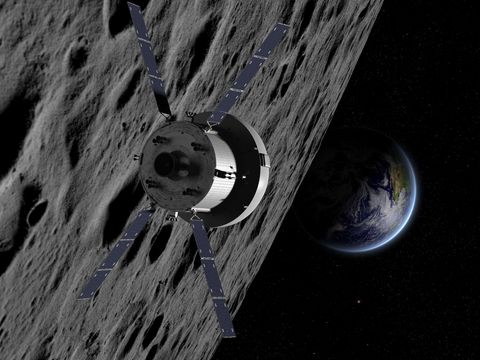
Orion European Service Module
NASA’s Orion will take humans back to the Moon. Airbus-built European Service Module provides propulsion, power, water and oxygen…
-
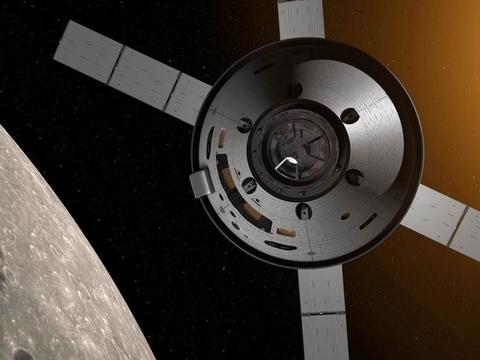
Space exploration
Airbus is at the heart of space exploration, designing and delivering innovative spacecraft, robots, scientific experiments…


The latest Space news
In the spotlight
-

Airbus delivers first batch of next-generation satellites for Eutelsat’s OneWeb…
Press Release
Space
Airbus delivers first batch of next-generation satellites for Eutelsat’s OneWeb constellation. Read more. -

Eutelsat orders 229 additional OneWeb satellites from Airbus
Press Release
Space
-

Artemis II crew touches down at Airbus in Bremen to celebrate a flawless flight
Web Story
Space
-

From cleanrooms to orbit: How Airbus is building end-to-end space sustainability
Web Story
Space
-

Artemis II: Why we are going back to the Moon and why it matters
Web Story
Space
