Video:
Humankind is made to explore, to share, to dream, to make the impossible possible. Delivering what’s needed, enriching our everyday lives, taking us home. Airbus makes the connection. We reach further to satisfy our curiosity, looking beyond horizons. We innovate to make a better tomorrow, to improve what is and to build what’s next, and to progress our world must be safe. When it matters most, Airbus is there to unite, to connect, to protect. This is our purpose. To pioneer sustainable aerospace for a safe and united world. Airbus: Made to matter.
Guillaume Steuer:
Good morning, ladies and gentlemen, and welcome to our Airbus Event Centre. Thank you for being here with us today for our annual press conference, where we will present and discuss our 2025 results, and a big thank you to all of you and all of those who are following us online today. My name is Guillaume Steuer. I look after External Communications and Media Relations for Airbus, and here with me to present the results are Guillaume Faury, our CEO, and Thomas Toepfer, our CFO.
Guillaume will start today by sharing a few highlights about last year, 2025, and Thomas will then provide you with more details about our financials. Finally, Guillaume will discuss our outlook and priorities for 2026. We’ll then move on to our Q&A session, which those of you following online can also take part in by submitting questions using the LiveE tool. As always with these things, this entire conference is going to be in English and there will be no simultaneous translations.
Now, ladies and gentlemen, as usual, please familiarise yourselves with our Safe Harbour statement, which you can now see on your screens. Please remember that in this conference, all forward looking statements, such as in our guidance, are based on assumptions, and as conditions may change so may our projections and plans.
Before I hand over to Guillaume for this overview of 2025, we wanted to share with you another short video, which we think captures some of the key achievements of Team Airbus in 2025. I hope you enjoy it as much as the teams enjoyed putting it together. We’ll be back with you in a moment after the video.
(After the video) Over to you Guillaume
Guillaume Faury
Thank you, Guillaume. Two Guillaumes on stage. Thank you and hello, everyone. Thank you for joining us here in Toulouse and online. You will have seen from the video that last year was a colourful and exciting one. 2025 was indeed a landmark year, characterised by very strong demand for our products and services across all businesses, in both civil and defence. We navigated a complex and dynamic global environment, our primary focus being to manage supply chain constraints that created a disconnect, or desynchronisation between production and delivery over the year.
In Commercial Aircraft, we continued to expand our industrial footprint to support our production ramp up. We completed the acquisition of certain Spirit AeroSystems work packages with the closing on 8 December, and we opened new final assembly lines in the US and in China for the A320. Going forward, the shortage of engines from Pratt & Whitney will require, this year, our ongoing focus to secure our delivery trajectory. I will get back to this point in a moment.
Our Helicopter division delivered a strong performance from programmes, and growth in services. This is true on the civil side, where we are maintaining our leadership position, and on the defence side, where our market share is growing.
Finally, in Defence and Space, we are reaping the fruits of the transformation of the division, and we are capturing the momentum created by increased defence spending in Europe and worldwide.
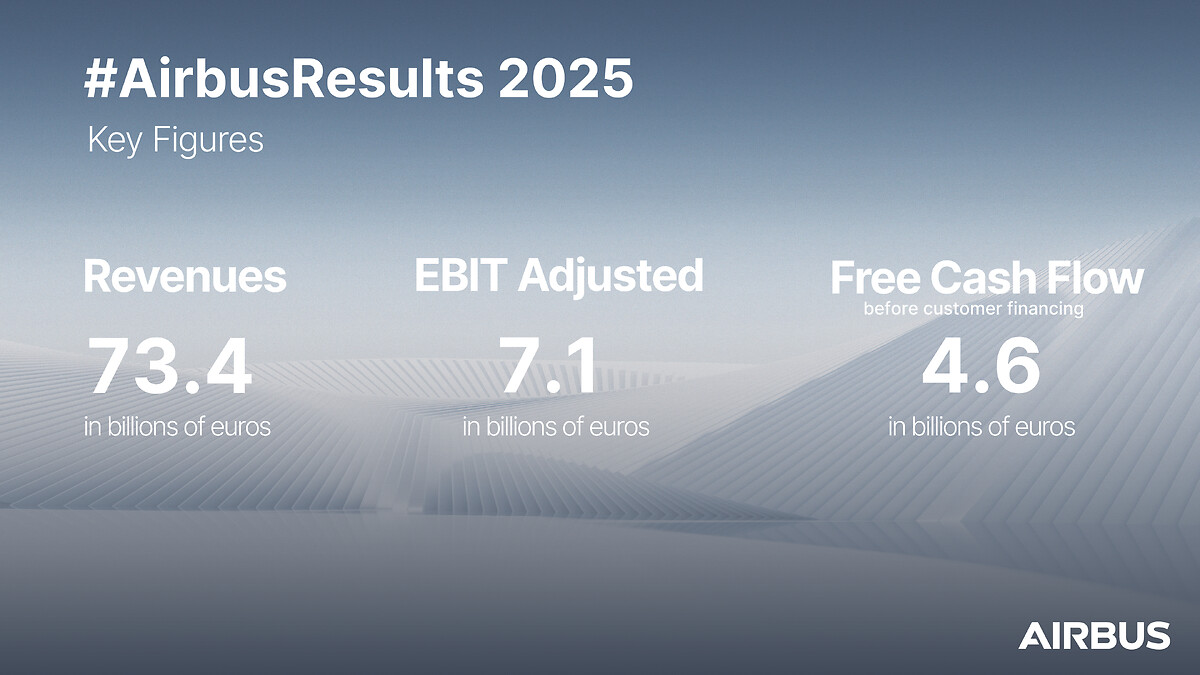
Overall, Team Airbus did a great job in 2025. We delivered on our commitments, meeting our updated guidance with 793 commercial aircraft deliveries. This demonstrated our collective resilience in the face of persistent and significant headwinds in our supply chain and in the broader global environment. Overall, this translated into a strong financial performance for 2025, with a record EBIT adjusted of € 7.1 billion and a record net income of € 5.2 billion, supporting our 2025 dividend proposals of € 3.20 per share. Thomas will give you more details on our 2025 financials in a moment.
Now let’s take a closer look at our Commercial Aircraft business. We disclosed our 2025 order and deliveries last month already, and I will go quickly over the numbers. Overall, we delivered, as I said, 793 aircraft to 91 customers, representing a year-on-year increase of 4%. The A320 panel quality issues we faced at the end of 2025 was a significant event that put pressure on our ability to deliver in an already back loaded year. We took immediate steps to address the challenge, putting a strong focus on quality and therefore unfortunately impacting our 2025 deliveries. During the year, we won repeat orders and key new customers in both single aisle and wide body campaigns, booking 1,000 gross orders, and we ended 2025 with a record backlog of 8754 aircraft. In 2025, we delivered 607 aircraft from the A320 family, and we booked 656 gross orders, bringing the backlog of the A320 family up to 7,163 aircraft. The A321XLR, our latest addition to the family, also continued to attract new customers.
Almost 39 years ago to the day, actually on 22 February 1987, the A320 made its first flight. Last year, it officially became the most delivered commercial aircraft of all time. We saw that on the video. I can’t resist taking a second to honour the Airbus pioneers who made it possible, and to thank the customers who have turned it into such a global success.
Switching to another innovative single aisle aircraft. On the A220 we delivered 93 aircraft in 2025, representing an increase of around 25% year on year, and we booked 49 new orders. So, 93 A220s, 607 A320s. That makes 700 single-aisle and then again 93 for the widebodies makes 793. On the widebodies, we delivered 36 A330s and 57 A350s. Looking at orders on the A330, we booked 102 gross orders in another strong year, confirming the high demand for this versatile aircraft. On the A350, we received 193 gross orders, underpinning the good commercial momentum. It was also a successful year for the A350 freighter variant with 28 new gross orders.
Now, looking ahead at the specific production ramp up plans for each programme. On the A220 family, the ramp-up is ongoing and paced by the integration of Spirit AeroSystems work packages and the balance between supply and demand. As we continue to make tactical adjustments on this ramp up trajectory, we are now targeting a rate of 13 aircraft a month in 2028.
On the A320 family, Pratt & Whitney’s failure to commit to the number of engines ordered by Airbus is negatively impacting this year’s guidance and the ramp up trajectory for this year. As a consequence, we now expect to reach the rate of between 70 and 75 aircraft a month by the end of 2027, stabilising at rate 75 thereafter. On the A330, there’s no change, and we continue to target rate 5 in 2029. There’s also no change on the A350, where we continue to target rate 12 in 2028.
Helicopters. 2025 was an outstanding year for helicopters, which delivered 392 units, 31 more than in 2024. We booked 536 net orders compared to 450 in 2024, with a book-to-bill well above one, both in units and value, including a strong contribution from the military segments and a good order intake from services. We continue to see positive momentum, in particular in military markets. Notable contracts included the order for 100 helicopters from the Spanish Ministry of Defence, the largest helicopter purchase by this customer. The Super Puma family kept performing well on the market with an important contract with the Royal Moroccan Air Force for 10 H225Ms signed in the second half of the year. We also saw the German armed forces reinforcing their commitment by firming up options for 20 additional H145M military helicopters. The division’s drone range also recorded notable successes, with contracts for the Flexrotor small tactical unmanned system, as well as for the larger VSR700 system, a 700-kilogram unmanned rotorcraft, which you see on the picture, which was ordered by the French Ministry of Defence. Finally, we are actively preparing the future of our helicopter range. The military version of the H160 made its maiden flight last year, ahead of first deliveries planned at the end of 2028. We also announced the launch of the H140, which you can also see on the slide, designed to complement our current range of light twin-engine helicopters, particularly for EMS emergency medical services. We did that at the vertical show in Dallas last year.
Now moving to Defence and Space. 2025 reflected one more year of record order intake, which stood at € 17.7 billion, corresponding to a book-to-bill of around 1.3. The performance of the division last year was also the result of our transformation efforts, efforts which are now paying off. Looking more closely at our activities. 2025 was an excellent year for the Eurofighter programme. We recorded an order for 20 aircraft from Germany, eight for Italy and we also welcomed Turkey to the programme with an order for 20 aircraft. To support this growing demand, we are ramping up production of the Eurofighter along with our programme partners. In 2025, we also recorded a first order for the new A330 MRTT+, an evolution of the existing MRTT, based on the re-engined A330neo, new engine on the A330. It’s an important milestone that ensures the world’s most successful tanker will remain successful for decades to come.
While on air power, and given how much has been written on the topic lately, let me say a word on FCAS. At Airbus, we believe that the European need for an ambitious future combat air system is unchanged. We also believe that an ambition of this scale can only be delivered through cooperation, fostering operational interoperability and lifecycle synergies for European air forces. However, the deadlock of a single pillar should not jeopardise the entire future of this high-tech European capability, which will bolster our collective defence. If mandated by our customers, we would support a two-fighter solution and are committed to playing a leading role in such a reorganised FCAS, delivered through European cooperation.
Now, coming back to our 2025 performance and looking at space systems, Airbus was selected by Eutelsat to build a further 340 OneWeb low Earth orbit satellites, LEO satellites, complementing the first 100 recorded in 2024. All these satellites will be produced at our Toulouse site, not far from here, and will be an important contribution to Europe’s efforts to strengthen its sovereignty in LEO constellations. In space, last year’s agreement with Thales and Leonardo to bring together our satellite and space services activities was obviously an important milestone. At Airbus, we firmly believe that by pooling our resources, skills and capabilities will be able to create a new leader rooted in Europe and able to compete globally. Scale will help increase industrial efficiency, lower costs, and ensure that Europe can maintain its autonomy across the strategic space domain. We’ll continue to work closely with our partners to ensure this proposed joint venture can be established as quickly as possible, while going through all necessary steps and approvals. Now, this concludes the overview of our 2025 achievements across businesses that I wanted to share with you. Handing over to you, Thomas, for a detailed look at our financials.
Thomas Toepfer:
Well, thank you very much Guillaume, and good morning to everybody in the room and online. I will now talk and take you through our key financial elements for the financial year 2025. Overall, I think we can say that in 2025 we delivered very strong financials across the board in a context of many challenges. Now, starting with the top line, you can see our 2025 revenues increased to € 73.4 billion, which is up 4% year on year. It mainly reflects the higher contribution from our divisions, the stronger service volumes across the business and also a higher level of deliveries, which was then partially offset by the weakening of the US dollar. Our 2025 EBIT Adjusted increased to € 7.1 billion from € 5.4 billion in 2024. Of course, let me remind you that in the financial year 2024, after the completion of the in-depth technical review of our space programmes, we recorded a total charge of € 1.3 billion. Now, in 2025, the higher commercial aircraft deliveries, together with a more favourable hedge rate and lower R&D expenses, were partially offset by the impact of tariffs, of which the vast majority actually occurred in Q4. It also reflects a stronger performance in both of our divisions.
If you look at the earnings by business, the Commercial Aircraft’s EBIT Adjusted increased to € 5.5 billion from € 5.1 billion a year earlier. That was driven by the increase in deliveries with a more favourable hedge rate and lower R&D expenses, and as I said, it was partially offset by the impact of tariffs, which we had to digest.
If you look at Helicopters, the EBIT Adjusted in that division increased 13% year on year to € 925 million. That is, of course, reflecting the higher deliveries as well as very solid growth in the service business.
Finally, our EBIT Adjusted at Airbus Defence and Space stood at € 798 million. That is reflecting the higher volumes and is also supported by the improved profitability in line with the mid-term trajectory that the division has given itself. It is of course, also the result of the successful transformation plan.
Now turning to the EBIT Consolidated reported. This was € 6.1 billion with the adjustments totalling a € -1 billion, and namely that € -1 billion includes a negative impact of € 622 million from the dollar working capital mismatch and the balance sheet revaluation. The resulting net income for 2025 is a record € 5.2 billion, with a reported earnings per share of € 6.61.
Last but not least, and you can see it on the right-hand side of the page, our Free Cash Flow before customer financing totalled € 4.6 billion in 2025. That mainly reflects the level of deliveries, the commercial momentum across all our businesses, resulting in very healthy pre delivery payment inflows. It was only partially offset by the planned inventory build-up, which is associated with the ramp-up across all the programmes that we have. Finally, our net cash position for the year stood at € 12.2 at the end of December, which also reflects the weaker dollar environment. I would just like to emphasise that our total liquidity is still very healthy and stands at around € 35 billion. With that, I would like to hand it back to you, Guillaume.
Guillaume Faury:
Thank you, Thomas. Our ambition to pioneer sustainable aviation and our corresponding roadmaps remain key priorities for Airbus. We took a number of significant steps in 2025, and let me mention a few.
During our Airbus summit last year, we presented an updated roadmap for our hydrogen aircraft research effort. This roadmap takes stock of the slower than expected development of the global hydrogen economy, and of our ambition to focus our efforts on solutions that would enable a commercially viable and competitive product. In line with this approach, we announced in June last year the signature of an agreement with MTU Aero Engines to collaborate on hydrogen fuel cell propulsion, the technology we have identified as the most promising for a future hydrogen aircraft. In parallel, we continue to mature a number of key technology bricks for our next generation single aisle aircraft, which we aim to bring to the market in the second half of the next decade. It will bring a step change in terms of decarbonisation and competitiveness, and we aim to reduce fuel burn by 25 to 30% compared with current modern generation aircraft.
On SAF, Sustainable Aviation Fuel, Airbus continues to partner with several airlines to accelerate their development. To overcome the logistical challenges of physically delivering SAF to market, we launched a new book and claim demonstrator. This allows customers to buy SAF and claim the corresponding CO2 emissions. Looking at our own operations at Airbus in 2025, we used 21% SAF in our aircraft and helicopter flights. This puts us on track to reach our goal to use at least 30% SAF in our operations by 2030.
Now, let’s have a look at our outlook and priorities this year and beyond. It starts with our guidance, which I will read out to you now. As the basis for its 2026 guidance, the company assumes no additional disruptions to global trade or the world economy, air traffic, the supply chain and its internal operations, and ability to deliver product and services. The 2026 company guidance is before M&A and includes the impact of currently applicable tariffs. On that basis, the company aims to achieve in 2026 around 870 commercial aircraft deliveries, an EBIT Adjusted of around € 7.5 billion and Free Cash Flow before customer financing of around € 4.5 billion.
In conclusion, what will Team Airbus be focusing on in 2026? The key pillars that underpin everything we do as a company are unchanged. Going forward, we will remain focused on safety, quality, integrity, compliance and security. Last year’s events, notably the A320 software recall, the ELAC topic, and the fuselage panel issues have only reinforced our resolve to put safety and quality first. Our primary focus in 2026 will remain ramping up production. In commercial aircraft, where global demand continues to show that people around the world want and need to fly, and in defence, where we intend to play a leading role in supporting Europe’s efforts towards sovereignty and security. Across all businesses, we’ll continue to prepare the future in order to deliver profitable growth. Across the group we’ll do so by maturing the technologies that will help decarbonise aviation and prevail on tomorrow’s battlefields. The world around us is changing fast and becoming more unpredictable. In this environment, it takes the daily commitment of Team Airbus to make a difference by delivering products that help to connect and protect people. This is why, in these volatile times, we remain guided by our purpose to pioneer sustainable aerospace for a safe and united world. On that note, inspiring to me, back to you, Guillaume.
Guillaume Steuer:
Thank you very much, Guillaume and Thomas, for those opening remarks. We will now start the Q&A session. Again, a few housekeeping remarks. For those of you who are in the room, please raise your hand and wait for one of our colleagues to come to you. Also, before you ask your question, we would ask you please, to state your name and the name of the publication you’re working for. For the media colleagues who are following us online, you are and can use the live e-platform for which you’ve received details, and you can submit your questions in writing. Please do so in English, and in case you are experiencing any kind of technical difficulties, please feel free to reach out to the communications team, the contact of which you have in the invitation. So, let’s begin the session now. We will start by taking questions from the room with our colleagues here. The floor is yours. Please raise your hands. We can start over here.
Jens Flottau, Aviation Week:
Thanks. Good morning. Jens Flottau, Aviation Week. Lars Wagner said in Dublin the other day that you would like to see a lot higher rate of production for wide bodies. I was wondering, Guillaume, what your view on this topic is? Related to this, how concretely are you looking at an A350 2000, a stretched A350? Finally, what’s the latest on the A220 500? Thanks.
Guillaume Faury:
Thank you, Jens. Yes, well, I agree with Lars. I’d like to see higher rates on the A350 as well, because we have very strong demand. Now, we are in a steep ramp-up from where we are today to rate 12 in 2028. That keeps us busy, but we’re also looking at what it would mean, what it would require, and by when, to significantly increase the rates on the A350. So, it’s not for today. I agree with Lars. We would like to see more, but we have to work and do the homework before we take decisions and move forward.
The A350 family relies on a very strong platform. The product is very successful. We book significantly more than we can produce in the short term, and we see a demand for a larger plane. So, that’s also something we are looking at, but again we are in the development phase of the freighter. It’s an important year for the freighter. We have to come to deliveries of the aircraft, so we are timing things one by one, but we are seriously looking at what the further potential of the aircraft is, and a stretch would be a natural evolution of the product. We are not at a point of decision. We are at the point of working, of analysing, of listening to customers, but that’s indeed something possible.
For the A220, a lot on our plate as well with the integration of the Spirit AeroSystems work packages and what it means for the A220 programme. So, we keep ramping up, but we hear loud and clear from the market that there is a strong potential for what is called a 500. That would make plenty of sense. We had the opportunity to say earlier that it’s more a question of when than if, while we are not yet at the when, and we are not yet there either. As you have seen, we have plenty of things to do, and we want to time things one by one, but this is also something we are seriously considering.
Guillaume Steuer:
Thank you, Jens. Thank you, Guillaume. We have a next question just in the middle here.
Jorge Penalba, Avion Revue:
My name is Jorge Penalba from Avion Revue. Hello. My question is for Guillaume about the new company that you are creating with Leonardo and Thales. Can you explain a little more of the process taken so far to integrate the company? Which of the goals that the companies have independently will be merged? Has a name already been decided? Thank you.
Guillaume Faury:
Thank you. I’ll start with the latter. There was a code name for this project at the very beginning, which is Bromo, and everybody’s speaking about Bromo. Bromo is not the name of the company, but it’s starting to become more than a code name. So, I don’t know, there’s no name decided and we’ll come to it later, but we’re just using this code name now to name this company. We are not at the point of integration. Actually, by law, we cannot do anything that is related to working together as a team or integrating as long as the closing is not done. However, we are working hard together to pass the milestones required to then be able to do the closing of this merger at a point in time. We are also obviously responding and presenting our files, especially on the antitrust side, to the authorities, starting with the European authorities. So that’s where we are, and as long as we are not together, those companies continue to play on the market and compete on the market as they were doing before.
Guillaume Steuer:
Thank you, Guillaume. We have a question over there.
Niklas Zaboji, Frankfurter Allgemeine Zeitung
Yes, thank you. Niklas Zaboji with Frankfurter Allgemeine Zeitung. Guillaume, on FCAS. Could you please give us some more explanations on the deadlock? On the one hand, there is this dispute with the governance. On the other hand, now, the German Chancellor said clearly that there are also different requirements between France and Germany. So, why the deadlock and do you still see chances to overcome this dispute? Then, on the two-fighter solution, are the three discussed options equally thinkable? So, either Airbus develops a new fighter alone, or together with Sweden, or joins GCAP, or do you have any preference for one of those three options discussed? Thank you.
Guillaume Faury:
Well, I think we would be wrong to be right too early. We’re in a programme that is called FCAS. We’ve spent a lot of time and energy supporting this programme that has a number of pillars. The so-called next generation fighter is one of those pillars, and it’s important to say that the other pillars are working well and making good progress. Namely the so-called combat cloud, the pillar on the remote carriers. The engine pillar is also making progress. On the next generation fighter, there is a deadlock that is linked to expectations on the governance that differ between partners, on what leadership means, what cooperation means. That’s one of the reasons for the difficulties. Also, under a certain governance, on the ability to reach the objective of the programme for the different customers. It’s up to the customers to express themselves on that one, I will not comment. So, we believe we are at a difficult juncture of the programme.
At Airbus, we continue to believe that the programme as a whole makes sense, and that we should not jeopardise the progress and the relevance of the other pillars. We need to find a way forward on the NGF pillar, expecting decisions from customers, and then we’ll see. We are not at the point of deciding on next steps before this step is past. We believe in European cooperation. We believe that if there’s a way forward with two fighters, it could be an opportunity to have other partners with us. It is up to our customers to decide with whom they want to join forces though, if it were the case. Again, we are not yet at that point.
Guillaume Steuer:
Thank you. We have a question just right here from Robert.
Robert Wall, Aviation Week:
Yeah. Hi. Robert Wall with Aviation Week. Just a quick follow up on the FCAS and an A400M question. On FCAS. The German chancellor said as part of the requirements review, he does want to ask the question, do they even need a sixth-generation fighter? So I guess the question, if there is an NGF divorce, how sure are you there’s even going to be a German programme for Airbus.
And then on A400M, a small housekeeping thing. What was the charge for? And then more broadly, how confident are you of this year getting top-up orders or new customers for the programme to keep production stable at eight a year?
Guillaume Faury:
You take the A400M, Thomas. I will take the first one.
I think the trend from manned to unmanned is very broad and very strong, and we see the capabilities of autonomous systems moving forward very fast. The question of going from manned to unmanned is on the table, the timing is very unclear. And the manned-unmanned teaming is also another capability that is being developed. So, I think it’s fair to raise the question. I think a lot of us believe that there will be a point in time, quite far in the future, where manned capabilities will be to a large extent replaced by unmanned. And the belief at this stage is that there is still a need for a manned fighter besides growing capabilities in unmanned. I think the question is on the table for a number of forces is whether they want to directly go to the next one, but then take the risk to be irrelevant for a certain point in time due to a lack of modern capabilities of manned fighters, or invest a lot of money on the manned fighters and then move forward to the next capability. There’s also the understanding that there could be a way to go to a capability that would be manned and/or unmanned, either at the same time or in time, moving from manned to unmanned. So these questions are on the table. Technology is moving very fast on programmes that take a lot of time to be developed. And what the Chancellor has expressed is a question that is in industry, that is in defence, and for which FCAS had found an answer: we want a sixth-generation fighter. But obviously this question will remain, and we see other players having not necessarily the same conclusion. I think that’s what the Chancellor has reflected in his remarks. That’s my understanding, at least. You should raise the question to the Chancellor directly.
Thomas Toepfer:
Maybe to answer on the A400M, the most important thing for us is that in 2025, the cash flow of the A400M was positive. And so that I think is a great success relative to what we have seen in the past years. That is what counts for us most. What you’re referring to is a little bit more from the accounting side. You may know the A400M is accounted for as an estimate-at-completion. So, we have to make assumptions for the entire remaining lifetime of the aircraft. What is reflected in the charges is twofold: one, an assessment of the production costs that we have for the A400M, but also to a certain degree, certain developments which we still are pursuing in light of the requests of the customer. And so those things together, if you take them over numerous years and discount them today, that gives you the charge. But I think, nothing really exceptional relative to what the programme is delivering.
Guillaume Steuer:
Thank you, Guillaume and Thomas, we have a question on our left here.
Hakan Çelik, Posta & CNN Türk:
Thank you. Hakan Çelik from Posta and CNN Türk.
My question is for Mr Guillaume Faury. In the context of growing transatlantic friction and visible erosion of strategic trust between the United States and Europe, how do you see this dynamic reshaping the defence and aerospace industry? On the other hand, with rising European defence budgets and increasing calls for strategic autonomy, how is Airbus positioning?
Guillaume Faury:
Thanks for the question. The way we look at it – and we looked at it before the incremental investment of European countries in defence – was that Europe was not spending enough money on defence. Data is available, I will not dive into the figures, but it was not by a small amount but by a huge amount. Not enough money on defence. Not enough money on defence from European defence manufacturers, therefore buying far too much from outside of Europe, and not buying smartly in the sense of buying too fragmented and not enough jointly for common needs.
The move that is now visible in front of us is going in the right direction. A clear increase in defence budgets, an intent to rely much more in the future on European players for Europe, to increase resilience, sovereignty of the defence system and therefore of the security of Europe, and through the efforts that are made on a number of fronts to cooperate and work jointly. We think we are at the very core of this. We can bring military capabilities to Europe at scale through the duality of our products: we develop technologies with civil and military applications. That gives scale and speed to our ability to come to market. We are today the largest EU defence player by order intake, and I think as well by turnover. And we have capabilities that correspond very well, that are well-aligned, with the capability needs that have been expressed by Europe looking at the overall picture. So, our strategy is to be there, is to be a defence player for military aircraft, for cyber, for helicopters, in space, to provide the systems, the capabilities that Europe needs. But beyond Europe also to serve the allies and the partners of Europe. So therefore, having a growing business. And we believe roughly the speed of growth in defence will be similar to the speed of growth in non-defence activities – in civil activities. Therefore, having on the next five-year horizon a balance between civil and military, which would probably remain around 80% for civil, 20% for military.
Guillaume Steuer:
Thank you. Guillaume, we have a question at the front.
Sebastian Steinke, Flug Revue:
Good morning, Sebastian Steinke from Flug Revue in Germany. I have a commercial aircraft question, please, concerning the A321. It is a huge success. Do you see a market maybe above it, just above it for maybe a bigger version or a separate programme? Because the growth of the market in Asia seems to indicate there is a need for a slightly bigger one as well.
And speaking about A321 and looking ahead to the next family, doesn’t the success of the A321 create a sort of pressure for you to stay close to it because it’s now like an almost global standard. Everybody has it. Everybody has pilots, spare parts, knows the family well. Can the next family be radical enough, or does it have to be close to the success model of the A321, thank you.
Guillaume Faury:
Thank you. Indeed, we see that demand and the core of the markets for the A320 family have moved from historically A319/A320 to A320/A321 to A321 and its upper versions, namely the XLR. We have a lot on our plate to deliver on those programmes and deliver in terms of production. So, we are focusing very much on stabilising the design to be able to serve production at scale, at speed, according to the expectations of our customers. And what I’m suggesting here is, as the core of the A320 family market goes to the A321, we will see the percentage of aircraft being A321 or A321 derivatives increase significantly. We suggested it in the foreword. But we don’t intend to add a next member to the family. We just move the centre of the family towards more A321.
When it comes to the replacement – to the successor of the aircraft – we do a transition every 20 to 25 years. In that case, it will be more than 40 years. And even if we have increased very significantly, the competitiveness of the aircraft, made upgrades, put new engines, new devices on the aircraft, it has to be a significant step. We’re targeting 25 to 30% fuel-burn improvement compared to the A320 family, and therefore it will be a very significant step. It will be a very different aircraft, a very significant step. Still, we want to stay at the core of what makes the success of the A320 family. So, we will see similar philosophies and concepts, but new technologies, new performance and new characteristics. It will be very significantly different at the end.
Guillaume Steuer:
Thank you. We have another question just in front of us here.
Leen Al-Rashdan, Bloomberg:
Hi, Leen from Bloomberg. On the 870 target, you’re obviously still in conversations with Pratt & Whitney. Could they potentially have bigger output? Are you hopeful that you could actually increase that number this year, or is this the best it’s going to get? How elastic is that target?
Guillaume Faury:
We release the guidance at the moment we release the guidance. And we do it with the information we have. Pratt & Whitney has resiled from the orders we had placed, and they had accepted for the volumes in 2026. We have to base our guidance on what they tell us now that they’re willing to commit and deliver. We’ll continue to work hard to enforce our contractual rights, which we believe are not respected in that case. But we also know that Pratt is facing a number of challenges. We are not happy with the outcome, but that’s what it is today.
As I said earlier this morning, if things change over the course of the year, we will take benefit of it. If it changes, obviously in the right direction, which we would expect. We have to adjust the production trajectory to, at least at the beginning, maintain opportunities. And that creates complexity in the ramp-up trajectory in the level of inventories we would accept moving forward. We have also to take care of the suppliers, all the other suppliers which have delivered and which continue to deliver on the ramp-up trajectory. So that creates complexity. And we are also very much focusing on the 2027 volumes of Pratt & Whitney engines to be back on track, at least in 2027, if 2026 is not better than what we see today. So we are where we are. We release the guidance at this point of the year with what we have. That is disappointing from Pratt & Whitney and we’ll keep working.
Guillaume Steuer:
Thank you. Guillaume, we have a question coming up online, which I will read out loud for the benefit of those in the room and on the call. It’s a question from Reuters, Tim Hepher.
You mentioned, Guillaume, on the analyst call, that Airbus is ready to enforce its contractual rights in the dispute with Pratt & Whitney. What does this mean in practice? Have you initiated or are you planning any kind of legal action?
Guillaume Faury:
We have a contract, obviously, with our friends from Pratt & Whitney, and we see that they are not respecting their contractual obligations. So, we want to enforce our rights. And indeed we have initiated a process according to contractual requirements of disputes. And I will not say more about it because then it becomes a commercial in-confidence relationship with them. But indeed I confirm we want to enforce our contractual rights.
Guillaume Steuer:
I think we had a question from the room first over there, and we’ll go back to the online questions after.
Wolfgang Borgmann, Aero International:
Wolfgang Borgmann, Aero International, Germany.
I have a question about the future A320 successor. You have been very public about the RISE engine concept that you’re supporting. But what about the Pratt & Whitney SWITCH, for example, in which you hold shares as well. Or any other engine option, like maybe Rolls-Royce? Are there any further developments you would like to share? And also about the new wing that you’re developing? It’s very quiet about that. What you presented last year as a concept, idea, or other technologies that you would include into the new A320 successor?
And my second question would be about SAF. It’s a more general question. Wouldn’t it be about time to tell the public that SAF isn’t there? That it’s just an idea. And now the USA are, I think, pulling out for the next three years at least and the development of SAF may remain just a drop on a hot stone. So maybe 1%, maybe 5% of the fuel needed. But I can’t see where it’s going to be made, where it’s happening, and when the general public will benefit from it.
Guillaume Faury:
Two important topics for us. On the A320 successor, we had the Airbus Summit earlier this year. We’ve been very transparent and open on what we do. Indeed, there is a number of technology bricks. Propulsion is one of them. Wings are another one. The wings are Airbus’ homework. And we’re working hard. It’s not just an idea or a project. It’s a lot of research technologies. And now we are at the test phase of the product and production processes to prepare for high-rate production of composite wings that will have a very large wingspan. And I don’t want to enter into the complexity of the technology, but that’s ongoing.
It’s ongoing also on the propulsion side, where there’s an important choice to be made later on whether we go for open rotor, for a ducted fan, obviously in both cases with gears, with transmissions to optimise the propulsion ratio. And that’s an important strategic choice that will impact the architecture. And we put these concepts in competition with each other. The open rotor technology is a more modern one, is a recent one. And we are working very closely in a very positive way with CFM on what they call the RISE project. And we are their partner to develop this technology and to look at the integration, what it would mean for the plane. We have important decisions to make later in the decade, going to 2030, where we intend to launch the programme. We’re not at the point of decision, but we are at the point of collecting all data that are required to make an educated decision that will be the best one for the programme. And indeed, we are working with all manufacturers that want to work on open rotor – there’s one mainly in CFM – and others, including CFM, on what alternatives could look like and what would be the best traditional geared turbofan, or what would become ‘traditional’ geared turbofan, option for the next generation. In both cases you have pros and cons. They are not the same ones, but we want to make the decision having de-risked, having understood, having tested as much as we can. And we are very happy to have this cooperation with CFM to go as far as we can before making a decision on the understanding of what an open rotor technology on a single-aisle aircraft of Airbus would mean, and how we would deliver something competitive, how we would certify and how we would have something reliable in service. And I stop here. There’s a lot I would be happy to share, but we have to be conscious of time.
Guillaume Steuer:
Thank you very much. We have one right here.
Timo Nowack, aeroTELEGRAPH:
Timo Nowack with aeroTELEGRAPH. I’ve got a question about the A319. You don’t have many orders for the A319, but on the other side you need the aeroplane for high-altitude airports, as I understand. So the question is, are you thinking about discontinuing the programme for the A319. And on the other hand, perhaps as a condition, how are you in developing the high-altitude abilities of the A320?
Guillaume Faury:
So, the answer is actually almost in your question. The specialised aircraft for high altitude used to be traditionally the A319, but we see more and more demand for longer versions, as I said earlier. So, A320 high altitude is something we are looking at to bring the altitude capability on the A320. And we want to respond to market demand that is mostly on the A321, to a smaller extent on the A320, less and less on the A319. So, the high-altitude capability should not stay alone on the A319. Now we have so much demand that we are not obsessed with high altitude, but that’s something we want to continue to retain in the future, on the A320 most likely.
Guillaume Steuer:
Thank you. Apologies, because we forgot the second part of Wolfgang’s question, which was on SAF, if I remember correctly. The public acceptance and the public understanding of what SAF can deliver. Correct?
Guillaume Faury:
Yes. I’m sorry I didn’t try to escape the question.
Wolfgang Borgmann, Aero International:
Well, there isn’t any SAF; it’s maybe 1% of the fuel needed, kerosene needed. And we’ve been talking about it for four years. We are at the same level. Nothing is really improving. In Europe, the energy costs are prohibitive, and I can’t see where else it would be produced in huge numbers right now that would build up what the politicians want. And the airlines and manufacturers hopefully.
Guillaume Faury:
So, at Airbus, we strongly believe that SAF is a necessary part of the decarbonisation roadmap and strategy. It’s the one that is less in our hands than the others. The planes, that’s very much something we can control. SAF is not the case.
On SAF, we are trying to play the role of catalyst. We’ve been engaging with a lot of people around the world: regulators, governments, airlines, fuel manufacturers, airports, you name it. The progress is slow, too slow. But it’s not zero. In Europe, we have a mandate for 2% and then 6% in 2030. And we see the volumes starting to grow in Europe because of the mandates. There’s a chicken-and-egg situation with demand and supply. And that’s really the conundrum we need to overcome.
That’s why we, Airbus, want to help by pushing for the book-and-claim system, which we believe has the potential to help, because today it’s not very relevant to produce SAF at some place in the world and then to use it in another place. You have to carry the SAF and you waste part of the benefit of having a decarbonised fuel, because the production of SAF around the world is indeed not where it has to be to fulfil the trajectory. It’s not hopeless and we see that countries like China, like India, the US – with the IRA at a point in time is probably not going in the right direction at the moment. But still, there’s production of biofuels in the US that is growing in certain areas of the US. There is potential for making this moving forward.
But the tipping point of acceleration of SAF is indeed more difficult to pass than we were expecting. There’s a price challenge. An aircraft that burns less fuel is both more competitive and more sustainable. Economy and ecology are aligned. With SAF it’s the opposite. A fuel that is more sustainable is less competitive. And therefore when you compare with your competitors, you’re better off from a competitive standpoint with less SAF than the others. We need a global framework. We need a global understanding, at least with the main regions of what SAF percentage would look like. Unfortunately, with the fragmentation of the world at the moment, we are not there and this is slowing down SAF. But we should not give up on SAF.
Guillaume Steuer:
Thank you. We have another question coming up online, which again I will read out loud. It’s from Ben Katz, of The Wall Street Journal. Hi, Ben. It’s a two-fold question on Pratt & Whitney. The first part is, can you explain what is keeping Pratt & Whitney from meeting its requirements? And is this related to the longer running metallurgy issue?
And the second part is do the Pratt & Whitney constraints complicate the decision on an A220 stretch? Could Airbus consider an alternative engine provider for a new variant?
Guillaume Faury:
I think I will not answer the latter part of it, because we’re not at that point. And the answer is mostly no; it doesn’t impact what we are considering for the A220. I think the first part is indeed the important one. I’d rather have Pratt & Whitney answering that question, but I will give my understanding of it. They have the combined needs at the moment of serving the production for new aircraft and serving the MRO capabilities for the recall campaign linked to the metal powder and linked to the rather low durability of the engine, and that puts stress on a number of bottlenecks – supply of certain parts which are too small in numbers to serve completely both needs – and the MRO capability to retrofit all engines in service and reduce the number of AOGs.
They’re confronted with those challenges combined at the moment, and we are very frustrated that they have decided to reallocate more to the in-service because they miss global capability and to the detriment of Airbus, where we think they should do more on increasing capabilities to serve both needs at the same time. We continue to work with them; to make them change the way they manage this. And as I explained earlier today, we are in those negotiations. So that’s the combined needs of the ramp-up on production of aircraft, on the retrofit of the metal powder issue, and the need for materials linked to the rather low durability of the current version of engine before the new version of the GTF, the Advantage, comes to the market.
Guillaume Steuer:
Thank you, Guillaume, we have a question in the room just here slightly to your right.
Thomas Boon, Simple Flying:
Hi, Tom Boon from Simple Flying. I wanted to go back to the open fan engine concept. And I know before you’ve talked about strapping it to the bottom of an A380 to test it. I wanted to know, is this still the plan? If it is still the plan, what does the timeline for flying it and testing it look like? And finally, do you see the A380 as a longer-term testbed for you, or do you think once the open fan’s done, that’ll be it?
Guillaume Faury:
Yeah. So, yes, it’s still the plan to fly the open fan, the open rotor engine. It’s still the plan to fly it on the A380, as was indicated before. And as we have explained, I don’t have the detailed planning in mind, and I would be too incorrect. So, I will not dare to give you a date. But we are preparing this, so it’s starting to be something now close to us.
And the future use of the A380, I’m not sure that we have yet taken a decision. It will be used for the open rotor testing. That’s the use we’re happy to do with it. Beyond this work, I don’t know. But it’s a convenient testbed because it’s really big and you can test large engines, still remaining small compared to the size of the aircraft. So in terms of safety, in terms of capabilities of testing, that’s really convenient. This being said, it’s a very large and expensive aircraft. So we’ll see moving forward what we do with our testbeds in general. But short term, we do the test for the open order as planned.
Guillaume Steuer:
Thank you. We’re going to go to our online followers again. We have a question from Charlotte Ryan from Aerospace America. Hello, Charlotte. I think the first part you’ve answered already regarding the Pratt & Whitney shortage situation. But taking the second part: does the failure to reach an engine agreement with Pratt mean that we should look at this year’s delivery target as more of a provisional goal than usual?
Guillaume Faury:
Each and every time we give an outlook, we give a guidance that’s based on the best and most reliable information we have and with a certain risk taking and prudence at the same time. At this point of the year, and under the current negotiations that we have with Pratt, the current guidance reflects what they are telling us they are committed to deliver. And I think I have answered already a lot to the first part of the question. What’s holding parts back is some of the challenges they have to face, and the fact that they don’t manage to overcome all of them at the same time. I’m not sure we can relate it to the supply chain challenges from the pandemic. It’s really linked to the need to ramp up volumes for new aircraft, combined with a huge recall campaign, the retrofit plan that they have to manage, and the MRO challenges that it is posing them – both on the availability of materials and on the size of the MRO network that needs to be mobilised to do this. We still have too many aircraft on the ground because of missing retrofits, and it’s an objective that we support, but we think they can do and they should do better serving both needs. That’s why we continue to work on this. If we have better outcomes later in the year, we will further adapt. But it’s not the case at this very moment, and we have tried hard and not obtained what we wanted. So, I would not take it as something that is very temporary. It’s pacing at least the beginning of the year and what we think is likely to happen.
Guillaume Steuer:
Thank you. And we have a question over there to your left.
Murdo Morrison, Flight Global:
Hi, it’s Murdo Morrison from Flight Global. I wanted to come back on an earlier question that was asked about the A400M and the prospects for that programme. And how secure is that programme in the medium term, do you feel, given the lack of export orders compared to the competition? And the second, broader question on European consolidation in defence – what do you feel needs to be done in Europe in order for Europe to go forward stronger as a region able to source its own defence requirements, rather than perhaps having to rely on US manufacturers?
Guillaume Faury:
So, first on the A400M, we are in a rather classical situation of going from initial contracts for launch customers to the export markets and the second wave, I would say, of orders. We see very strong and positive feedback from operators, from the air forces that are flying the A400M. The A400M used in operations in a certain number of places of the world has been seen as very successful, and the air forces that operate the A400M speak very positively about it.
We are coming not far from the end of the launch contracts, so we continue to have aircraft to deliver, but we see that this is for the next few years, and we are indeed engaged in a number of campaigns that are promising, but take time to materialise, especially in this overall environment. And we see that Europe has defined airlift needs as one of the capability gaps so we hear very clearly that there will be a need for additional A400Ms, but the timing becomes a challenge. So that’s really the nexus of when those new campaigns kick in. And how low do we need to go and for how long on the assembly of aircraft before we see this second wave of aircraft being manufactured. So, we think the product is strong, it is competitive, it is – from a military standpoint – very effective. And we are optimistic about the mid-term and the long term. But we have to navigate that transition. That’s what we are doing currently.
What would it need to make Europe stronger? And what about consolidation when it comes to defence in Europe? I think we are probably the ones with the front foot forward when it comes to European cooperation in defence. That’s what we are. That’s what we do. And when we think there’s a larger need for consolidation, cooperation, for instance in space, in satellites, we do it and we are happy to find partners that are doing it as well.
I think the short answer to your question is we need consolidation of the supply, as I call it, industrial consolidation of players across borders. That’s very often what is difficult. And we need also consolidation of demand, meaning governments, customers, military customers coming together for common needs at the same time to trigger scale. And when we work at scale in Europe, we are very competitive compared to our American colleagues. But when we are very fragmented and we have smaller demand not aligned in terms of timing across Europe, it’s very difficult to launch and be successful on programmes with the right scale. At Airbus, we are trying to be positioned where we can make a collaboration in defence in Europe happen and that’s what the current programmes we’ve been discussing this morning – the A400M, the MRTT and on the helicopter side – deliver.
Guillaume Steuer:
Thank you, Guillaume. We have someone in the room just in the centre here.
Leonard Berberi, Corriere della Sera:
Hi, Leonard Berberi from the Italian newspaper Corriere della Sera. I have a couple of questions. First one, in 2025, after seven or eight years, Boeing surpassed Airbus on aircraft orders. How much is that a consequence of your own success in these years? Because you took a lot of orders in these years, also because of Boeing’s missteps, and how much is related to the fact that now Boeing has a new head of sales, Donald J. Trump?
And the second question is related to the spat between United Airlines and the engine manufacturer about the A350. If you want to give a comment on that?
Guillaume Faury:
Sorry I missed your second part of the question.
Leonard Berberi, Corriere della Sera:
So, the spat between United Airlines and the engine manufacturer on the A350, I mean, in the last case. Thank you.
Guillaume Faury:
I don’t know how to comment smartly on that one, so I will use my joker.
So, when it comes to the order intake, it’s quite unique that we had so many years in a row where our level of order intake was higher, and in some cases much higher, than the main competitor. This has led to a gap, a difference in backlog, that is very significant. And as we have a backlog that is so big, what it is today, we have sort of 10+ years of order intake and taking book-to-bill of 1 in that situation means we continue to extend by one year, every year. So, we are satisfied with it. It’s difficult to do more than this. And there is a sort of catch-up effect that takes place and that we were to some extent expecting.
Now it’s true as well that Boeing, the team Boeing, has been well supported in a number of very large and important campaigns on more political grounds. And that’s something we have to live with. But we continue to believe that competitiveness of the product, relevance of our aircraft, satisfaction of customers, aircraft that deliver performance, competitiveness for the airlines will remain criteria of choice, and we remain very focused on having the best aircraft, the best plane. We think that’s what will protect us moving forward. We are not unhappy with the picture that we have created over the last years. It puts us in a very strong position.
Guillaume Steuer:
Thank you, Guillaume, and indeed, on your other questions, I think that’s a question more for United and Rolls in this case. We have a question to the left again over there.
Olivier Bonnassies, Airfinance Global:
Olivier Bonnassies with Airfinance Global. A question on commercial and specifically on the A220 programme. No question on the 500, don’t worry! I noted the amendment on the production rate to 13 aircraft a month by 2028. I think there was a previous forecast, maybe two years ago, for 14 aircraft a month by 2026. You mentioned in your remarks that the production rate would be affected by the integration of Spirit. Can you talk to us a little bit more about the performance of the A220 in terms of sales over the past two years because it’s been a bit disappointing. And what is your forecast this year? So again, the production rate, is it a reflection of Spirit only or also the performance of the sales on the A220 market? Thank you.
Guillaume Faury:
Thank you. Indeed, we have adjusted in the last two years, I think, the shape of the trajectory. We were initially targeting 14. Now we say 13 for 2028. That’s the result of what we call ‘balance between demand and supply’. We think we can stay at rate 13. We can sustain a rate 13 moving forward based on the demand we have. We want also to position the product at the right place when it comes to the price. And therefore there is a price/volume discussion that takes place to go to profitability for the programme. And that’s something that is important to us. So, mid-term, that’s more balance between demand and supply. Short term, we are navigating the difficulties of the ramp-up on Spirit and on the work packages coming from Spirit, namely the wings. So, there’s no big change in the short term. It’s more tactical changes and then going to the rate 13, which we believe is a good balance.
On your comments or your question on demand. Yes, we have good campaigns ongoing. You saw the news at the beginning of this year. We think demand for the A220 is there. The product is making progress in terms of operational reliability, in terms of customer satisfaction. And it’s going to be really where it has to be. So we are very comfortable, and we trust the power of the A220 to continue to be ordered in the numbers we need to sustain the production rates.
Guillaume Steuer:
Thank you, Guillaume. So, we are reaching the end. We’re going to take a quick one from Véronique Guillermard from Le Figaro who’s following us online. Hello, Véronique. Do you expect the Eurodrone programme to be abandoned?
Guillaume Faury:
It’s a bit digital. No, I don’t think we are there. There’s an ongoing discussion between customers on the way forward, and we have the majority of customers who really want this product, who continue to back the demand, and the programme. So, I think it’s likely to continue.
Guillaume Steuer:
Thank you. We have one more.
Hakan Çelik, Posta & CNN Türk:
Thank you so much for this opportunity. Considering Turkey’s involvement in the Eurofighter programme (by the way, it will be the first non-US jet for the Turkish Air Force) and the long-standing partnership with the A400M with Turkey, I mean TUSAŞ. And how do you assess Turkey’s deeper integration into the European defence programmes in the changing defence and global environment as a NATO member and your partner? Thank you so much.
Guillaume Faury:
Well, first on the A400M, the cooperation with Turkey is excellent and that’s a very positive experience on the industrial side. But I believe as well, in the cooperation of Turkey with European partners in the programme, Turkey as a country and as a customer. Indeed, the steps made on the Eurofighter are important because it means these European partners support, agree, support the fact that Turkey will become a partner for this important military capability. And I think that’s one more step of cooperation between NATO and Turkey as NATO allies. So that’s a step in a broader cooperation with Turkey coming closer to the other European countries. We have to make your fighter for Turkey a success, like A400M was a success, to keep moving forward.
Guillaume Steuer:
Thank you. Guillaume. And this is going to be the end of the question-and-answer session. Sorry Stefan, we’ll discuss later. Thank you all for the great questions. And thank you, Thomas and Guillaume, for the answers. We’ll bring our press conference to a close now. Once again, a big thanks to all of you who joined us either physically or online. And a warm thank you as well to all the great Communications colleagues who helped prepare and run the event today. If you have any follow-up questions, of course, please feel free to reach out to your usual contacts in the Media Relations team, who will be obviously happy to support. So, we wish you all a great rest of the day and we thank you again.
Guillaume Faury:
Thank you very much.
Thomas Toepfer:
Thank you very much.