
Amid the flames
How Super Puma operators tackled Europe’s record wildfires

The summer of 2026 has pushed emergency response teams to their absolute limits. Fortunately, during this extreme scenario, the Super Puma fleet has proved to be equal to a task as critical as it is gruelling.
With over 640,000 hectares burned across Europe this summer, including more than 295,000 in Spain and 115,000 in France*, the ferocity of this season's wildfires gave aerial crews no respite. Several European operators deployed their Super Pumas on firefighting missions. True to its reputation as a multi-purpose Swiss Army knife, a single platform seamlessly combines heavy water drops with the direct transport of ground crews to the fire line and emergency evacuations in critical situations.
Capable of dropping over 4,000 litres using a water bucket or belly tank, these aircraft can deliver up to 50,000 liters per hour onto the flames when a water source is nearby. This capacity to deliver such a high volume of water is supported by rapid scramble times, taking off in around eight minutes, alongside exceptional manoeuvrability to navigate narrow canyons or valleys and operate under extreme heat and high-altitude conditions.

Aerial view of Unidad Militar de Emergencias' Airbus H215 during firefighting mission
On the front line
In France, Airtelis and SAF deployed six H225 and H215 Super Pumas to tackle a fire season that exceeded the extreme intensity recorded in 2022. Together, the operators completed over 2,250 flight hours and performed more than 14,000 water drops, discharging over 56 million litres of water. The aircraft demonstrated their ability to drop water every three minutes on certain fires, maintaining maximum availability without any technical breakdowns causing prolonged downtime. "Experience gained over the past six seasons helped maintain a very high level of efficiency," according to Laurent Reynaud, Head of Development at Airtelis.

Airtelis performing water bucket drops with the Airbus H215
Meanwhile, Avincis completed a total of 642 missions and over 1,500 flight hours across Spain with its five deployed Super Pumas, averaging close to 300 hours per aircraft. In total, they carried out approximately 22,000 water drops, dropping around 66 million litres. Operating continuously from bases in Andalusia and Castilla-La Mancha, they also provided broad coverage across the entire Spanish territory. "This fire season has been considerably more demanding than previous ones. We have faced a large number of major wildfires, creating particularly challenging conditions for both our crews and the helicopters," explains Luis Alsina, Chief Pilot of the H215 fleet at Avincis. Alsina adds that "the H215 is a highly versatile, fast and agile helicopter, particularly considering its size. From a pilot’s perspective, it is a pleasant and predictable aircraft to fly, which makes the flying experience comfortable and gives crews confidence".

Avincis' H215 conducting water drops during firefighting mission in Spain
The reach of these operations extends well beyond European borders. Heli Austria completed 915 flight hours on firefighting missions with its fleet of four H215s, making 6,929 drops in environments as varied as Chile, South Korea, Sardinia, Austria, Germany, and France. This global presence demonstrates how the same rotorcraft serves year-round across both hemispheres. "Our Super Pumas performed very well throughout the season. Their water capacity of around 4,000 litres and ability to refill close to a fire allow us to maintain short rotation times when conditions permit. They proved effective in both planned seasonal deployments and short-notice missions," explains Roy Knaus, CEO of Heli Austria.

Heli Austria's Airbus H215 en route to support operation
Public force and dual nature
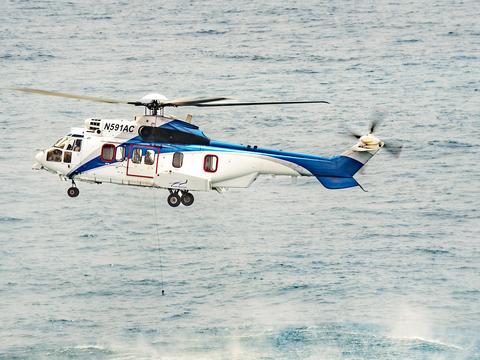
The dual-use concept proves its value during major environmental disasters. As the Super Puma is the only civil certified heavy helicopter, it can be utilised during crises. This enables institutions to pool resources and join forces when responding to climate emergencies.
This versatility is reflected in Spain's Military Emergencies Unit (UME - Unidad Militar de Emergencias), whose two Cougar helicopters integrated into the Emergency Helicopter Battalion remained permanently deployed throughout the wildfire campaign. The military unit responded to 14 firefighting operations in critical areas including Girona, Huesca, Castellón, Zaragoza, Guadalajara, Madrid, Ávila, Zamora, Cáceres, and Valencia, logging around 260 flight hours. Thanks to the platform's dual nature, military crews provide vital tactical transport and water-bombing support directly alongside ground firefighters.

Airbus H215 using a water bucket in support of UME firefighting operations in Spain
*European Forest Fire Information System (EFFIS)
Fighting fires with the Super Puma family: Frequently asked questions (FAQ)
| What was the overall impact of the 2026 European wildfire season? |
| Over 640,000 hectares burned across Europe during the summer of 2026, including more than 295,000 hectares in Spain and 115,000 hectares in France (according to EFFIS). |
| How much water can a Super Puma helicopter carry and drop? |
| Equipped with a water bucket or belly tank, a Super Puma can carry over 4,000 litres per drop and deliver up to 50,000 litres of water per hour onto active flames when operating near a close water source. |
| How quickly can Super Puma helicopters respond to a wildfire? |
| The Super Puma can be airborne in under eight minutes. |

Rotor magazine
Stay up to date with our latest innovations and get the latest news from civil and military helicopter operators carrying out vital missions around the world.
Media gallery
Super Puma
-


UME crew board Airbus H215 in preparation for firefighting operation
-


Avincis' Airbus H215 fills water bucket for firefighting support
-


Crew prepare for firefighting operation with Avincis' Airbus H215
-


Airbus H215


Discover more
-

Power to spare: Helicarrier’s H215 Super Pumas have the engine to get the job done
Frederic Carrier explains how the H215 Super Pumas support critical firefighting and construction missions in Canada.
-

A baptism of fire in Albania for Hungary's H225M helicopters and crew
In July 2025, the Hungarian Air Force H225Ms supported a fire fighting mission in Albania, delivering 500,00 litres of water…
-

Send in the Super Puma for aerial firefighting operations
Custom Helicopters CEO Jed Hansen explains the impact the Super Puma is having on the company's vital firefighting operations.
-

Aerial firefighting
From supporting first responders with crucial water drops, Airbus helicopters and UAS solutions play a vital role in keeping the…
-

H215
The Airbus H215 Super Puma is a heavy-lift helicopter with 866 km range and a 4,500 kg sling load, designed for demanding…
-
H225
The H225 is the aircraft of choice for operators across the globe for its long-range, all-weather search and rescue capabilities.


Related news
Continue reading
-

Amid the flames
Web Story
Helicopters
Super Puma operators battled Europe's extreme wildfire season, discharging over 122 million litres of water across major blazes in Spain and France. -

Romania orders 12 Airbus H225M multirole military helicopters
Press Release
Helicopters
-

Shaping the future of flight testing
Web Story
Helicopters
-

Saving lives with Ecuador's H145 "Arpías"
Web Story
Helicopters
-

A higher power to care
Web Story
Helicopters
