
Essential for survival: The future of military rotorcraft

In the increasingly challenging geopolitical situation, countries across the world are analysing how to ensure their armed forces remain as strong as possible. Airbus Helicopters’ Head of Programmes, Stefan Thomé, explains how the company’s policy of continuous development has built a range ready for essential missions.
“Military requirements especially drive innovation... because military products are built for either superiority or survival – or both,” says Stefan Thomé. While Airbus offers the largest dual range of civil and military helicopters on the market, Thomé is highlighting the key role that continuous development has in terms of delivering military helicopters that are designed and built to be decisive. Far from being a range of civil helicopters with some basic adaptation for military operations, the company’s military products are significantly enhanced by a series of ongoing innovations. For proof, Thomé also points to France’s H160M Guépard and the mid-life upgrade to the Tiger as two of Airbus Helicopters’ largest ongoing investments. Such improvements will also pave the way for the next generation of military rotorcraft.

Airbus Tiger
Co-creating evolutions
Continuous development is also becoming something that operators and OEM work on together. Previously, rigidly defined multi-year contracts agreed between OEM and client introduced new technologies, but there has been a shift in doctrine. “Those times are gone,” says Thomé. “Instead, militaries co-create and co-develop solutions, industry and militaries together create solutions – that’s something new.” Thomé talks about Airbus Helicopters products benefitting from an entire ecosystem that supports the development of new technologies.

Bundeswehr's Airbus H145M
Universities, suppliers, partners and of course, Airbus’ own Innovation teams constantly research and test new possibilities. Ongoing capability demonstrations given to military operators then lead to the continuously evolving functionality at the heart of Airbus Helicopters’ products. “Modular architectures also provide the customers with the ability to plug in their own changes,” states Thomé. An example of this in the current range is the H145M. “The helicopter’s versatility means users can take this helicopter and quickly convert it from, let’s say, a training helicopter to a reconnaissance helicopter, and from a reconnaissance helicopter to a light attack helicopter,” points out Thomé. Continuous development of its connectivity technology puts the H145M firmly on the cutting edge, allowing it almost to act as a flying command post, like a node in a vital data network, dramatically reducing crew workload and enhancing situational awareness in the cockpit.
Unsurprisingly, the company’s current pinnacle of continuous development in its military range is the H160M. Special military systems, weapons and FlytX avionics tailor it to military needs.

Airbus H160M
Connected to the future
Airbus’ in-service range of military products continues to evolve and Thomé highlights the teaming capability which “significantly extends the horizon of our helicopters. We intend to be drone agnostic, so it does not matter which drone we team with.” Of course, a future where teaming and connected battlefields co-exist necessitates further development. “Whenever you connect products, connectivity and sensors, then data is involved,” explains Thomé. “Receiving, sending, processing and storing data, as well as data security is becoming increasingly important. And we cannot think of our products – whether helicopters, drones, ground stations – in isolation. We need to think of them as networks. This digital aspect is really another key strategic and important element for products, especially future military.”

Airbus and H145M in flight during Musher exercise

Rotor magazine
Stay up to date with our latest innovations and get the latest news from civil and military helicopter operators carrying out vital missions around the world.
Media gallery
-


NH90 Standard 2
-


Airbus VSR700
-


M-Days-CDPH-9150
-


EXPH-2298-38
-


Aliaca VTOL_02
-


NH90 Sea Tiger
-


Airbus H175M


Discover more
-

Military helicopters
With some 19,000 helicopters delivered in 150 countries, Airbus Helicopters supplies almost one-third of the world’s rotorcraft…
-
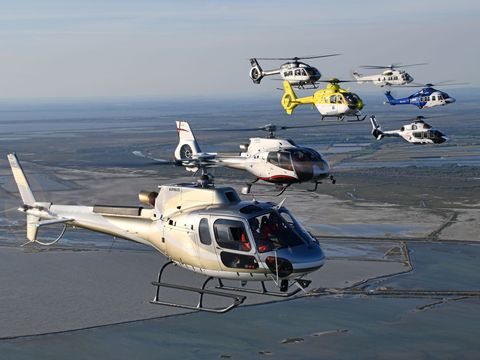
Civil helicopters
From single and twin-engine light and medium helicopters to those in the eleven-tonne class, Airbus has the right product for a…
-

Uncrewed Aerial Systems
Airbus UAS: Explore advanced uncrewed aerial systems for military, government and commercial missions, including combat, ISR, and…


Related news
Continue reading
-

Amid the flames
Web Story
Helicopters
Super Puma operators battled Europe's extreme wildfire season, discharging over 122 million litres of water across major blazes in Spain and France. -

Romania orders 12 Airbus H225M multirole military helicopters
Press Release
Helicopters
-

Shaping the future of flight testing
Web Story
Helicopters
-

Saving lives with Ecuador's H145 "Arpías"
Web Story
Helicopters
-

A higher power to care
Web Story
Helicopters
