
A330 Multinational MRTT Fleet: six years of European strategic cooperation
As the Multinational A330 MRTT Fleet (MMF) celebrates six years of successful operations, we take a look at this key programme, which could serve as a model for a future multinational A400M fleet.

Earlier this year, NATO officially declared Full Operating Capability (FOC) for the MMF fleet. This milestone marks the fleet’s readiness to deploy its air-to-air refuelling, strategic airlift and aeromedical evacuation capabilities worldwide.
“To mark the occasion, we attended a celebratory event at the Eindhoven Air Base in the Netherlands,” recalls Thomas Roensch, Programme Director NATO Countries at Airbus. “During the commemoration, a video of the A330 MRTT and our people manufacturing it was shown, and I realised the profound connection that exists between industry and the military in this programme. The military officials expressed their high satisfaction with the aircraft’s performance and operational setup, while the personnel of the MMU [Multinational MRTT Unit] praised the aircraft’s quality.”

Members of the ‘Airbus’ MMF team’ (from left to right): Thomas Roensch, Octavio Manjarres and Víctor del Valle.
A proven model of pooling and sharing
The MMF framework, which currently comprises the Netherlands, Belgium, Germany, Luxembourg, Norway, the Czech Republic, Sweden, Denmark and Finland jointly finances the acquisition and operation of the Airbus A330 MRTT fleet. The tenth aircraft is set to be delivered in September, and the fleet is expected to grow to 12 by 2029.
What began as an ambitious vision has matured into a cornerstone of Alliance capabilities, granting participant nations the exclusive right to operate NATO-owned assets within a highly efficient pooling arrangement. Roensch says that the programme is a prime example of Europe working together to optimise costs and achieve a credible deterrent: “For smaller nations unable to afford the significant overhead of managing individual, standalone aircraft, this pooling framework offers optimised, seamless access to cutting-edge military aircraft capabilities.”
This perspective is shared by Gemma Martín Ferrer, MRTT MMF programme manager at Airbus: “This European scheme was a risky but smart strategic decision. It has proved that European nations can unite under a common budget to deploy state-of-the-art capabilities anywhere in the world.” Martín also underlines that the direct management by NATO Support and Procurement Agency (NSPA) has delivered a more agile experience, fostering a constructive environment focused on joint problem-solving.
This successful model of European defence collaboration was in the spotlight at the NATO Summit in Ankara on 7 July, where a Letter of Intent was signed to create an A400M Multinational Fleet, similar to the current MMF programme.

Military Aircraft Parade - ILA Air Show 2022
The A330 MRTT can refuel more than 25 different aircraft using either the hose-and-drogue or the boom refuelling systems. It can also use the fuselage refuelling unit to refuel large aircraft equipped with a probe, such as the A400M or another A330 MRTT.
An aircraft continuously on duty
The operational infrastructure spans a main operating base in Eindhoven, a forward operating base in Cologne, and a third planned base in Karup, Denmark, ensuring the fleet remains permanently on duty. Octavio Manjarres Navacerrada, MMF Services programme manager at Airbus, notes that dedicated Airbus teams handle technical support, logistics and warehouse management at these sites. “Multinational crews stand ready 24 hours a day, 365 days a year, ensuring that aircraft configured for air transport and air refuelling operations or medical evacuation can depart within 24 hours.”
To bolster long-term readiness, flight crews training will progressively transition from Airbus’ International Training Centre in Seville to the Air Mobility Training Center in Rijen, Netherlands, which will host an A330 MRTT full mission simulator developed by Airbus for NSPA. Manjarres views this setup as far more than a standard client-supplier relationship, describing it as a “true partnership built on constructive collaboration.”
Tasked by the European Air Transport Command (EATC), MMF operations have ranged from air policing over Greenland to vital deployments along NATO’s eastern flank. Manjarres points to a significant increase in operational demand since the beginning of the war in Ukraine. Multiple aircraft are routinely active in Air Shielding missions alongside allied fighter jets to secure regional airspace. Beyond collective defence, the fleet has repeatedly proven its versatile crisis-response value, executing critical evacuations in Sudan and supporting relief efforts following natural disasters.
Looking toward the end of the decade and the goals of Europe’s Readiness 2030 plan, Airbus is already coordinating preparations to support planned increases in crews, equipment and operations.
Airbus Defence and Space is establishing a second A330 MRTT conversion centre at its San Pablo plant in Seville, Spain. Scheduled to be operational by the end of 2027, the facility will double Airbus's combined production capacity from five to seven aircraft annually. The site will also host a new A330 MRTT MRO hangar, scheduled to commence maintenance services for the MMF fleet in early 2027.

A330 MRTT MMF in Pitch Black 2024
Expanding capabilities and driving innovation
To maintain an operational advantage, Airbus is now focusing on further enhancing the A330 MRTT. Driven by the current global security landscape, enhanced survivability has become a paramount requirement.
Víctor del Valle Fernández, MRTT upgrades, campaigns and avionics manager at Airbus, outlines that this evolution represents a major qualitative and quantitative leap. “Self-defence capabilities are increasingly demanded by clients to protect aircraft flying closer to active crisis points,” he highlights. Other updates will focus on improved satellite connectivity and cybersecurity and anti-jamming.
These enhancements will be integrated on A330 MRTT aircraft deliveries over the next few years. Furthermore, as part of the A330 MRTT+ evolution, Airbus has already certified its tanker aircraft for automatic air-to-air refuelling (A3R) boom operations day and night. The company is now actively exploring autonomous hose refuelling technology.

A330 MRTT MMF Eurofighter
A blueprint for future military aircraft programmes
The success of the MMF programme demonstrates that European countries can align their industrial expertise with shared security objectives. As nations seek to streamline procurement processes, optimise defence budgets and maximise industrial synergies, the pooling and sharing model pioneered by the A330 MRTT fleet could be applied to other vital air transport platforms, such as the A400M tactical airlifter.
Thomas Roensch concludes that by replicating this collaborative structure, European nations can continue to safeguard strategic autonomy, share logistical footprints and ensure that joint forces are ready to respond wherever and whenever necessary. “Strategic air mobility similar to air-to-air refueling is a joint mission and both are important contributors to a solid European military deterrence,” he adds.
A400M and A330 MRTT - The Multinational Fleet
Discover more
-
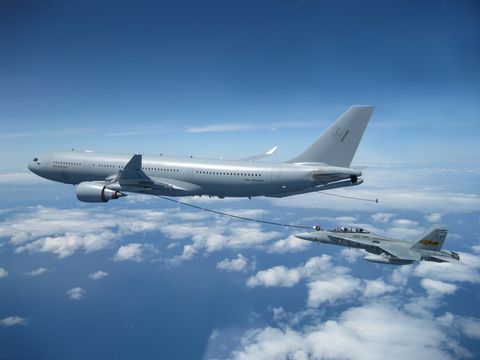
A330 MRTT
A combat-proven, highly versatile tanker based on the A330-200, the A330 MRTT sets the benchmark for multi-role tanker aircraft.
-
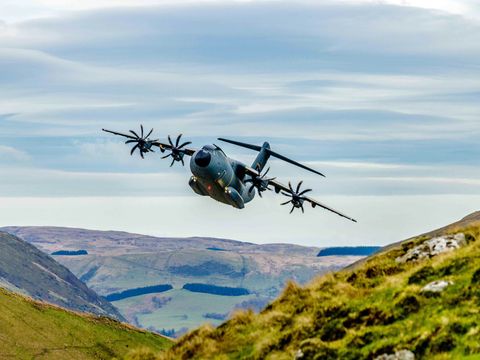
A400M
The Airbus A400M is the most advanced airlifter, capable of carrying strategic loads, delivering to unprepared airfields and…
-
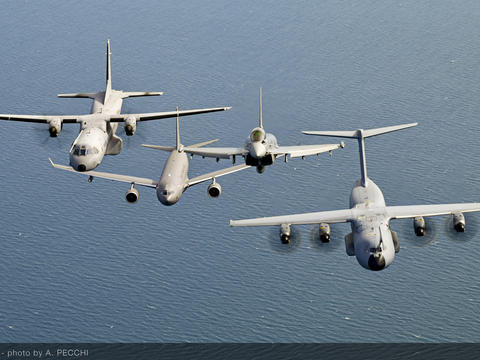
Military Aircraft
The company’s military aircraft portfolio includes the Eurofighter combat aircraft; the A400M, C295 and CN235 airlifters; and the…


Latest Defence news
Continue Reading
-

Timber Express: Virtual battlespaces as the future of testing and training
Web Story
Defence
Real jets, synthetic threats: Airbus supported the Timber Express exercise of the German Air Force in summer 2026 and trialled a new digital paradigm. -

Airbus networked intelligence: Shaping the future of autonomous UAV missions
Web Story
Defence
-

A400M Atlas: On a mission at the edge of the world
Web Story
Defence
-

Airbus spearheads new E2D European defence tech fund
Press Release
Defence
-

Bird of Prey: the Airbus answer to one-way attack drones
Web Story
Defence
