
Meet the versatile Airbus robot automating aircraft seat installation

Robotics in aircraft manufacturing frees up resources. It relieves workers of repetitive or uncomfortable tasks to better focus on the wider production ramp-up. CabinMarker, a four-kilogramme robot developed by Airbus Robotics, is a good example of how humans and machines can interact to boost efficiency on aerospace’s shop floor.
Today, Airbus’ greatest challenge is to sharply increase production while preparing a next generation of commercial aircraft and the industrial system needed to build it.
The pressure to manufacture safely, faster and with the highest levels of quality has never been greater. For Airbus, the solution isn’t just to hire more hands. It’s giving those hands a smarter set of tools, including time-saving, resource-freeing robots.
Robots free resources for the production ramp-up
Robotics at Airbus has moved beyond the large stationary arms used for heavy lifting. Today, automated technologies are being introduced to the company’s industrial system.
From exoskeletons that help workers avoid musculoskeletal strain to the FlexTrack drilling robot, the goal is simple: to identify the most repetitive, physically demanding tasks and hand them over to machines. This allows shop floor operators to focus on more complex, high-value tasks that require human ingenuity and craftsmanship in support of accelerating production.
To boost this transformation, Airbus Robotics was created in 2023. By bringing robotic expertise in-house, Airbus has transitioned from buying technology to creating it. This shift ensures that the company’s industrial set-up is engineered by those who understand aircraft production best.
Introducing CabinMarker: small robot, big impact for production automation
The latest member of the family is CabinMarker. Weighing just four kilogrammes, it is the first robot to be fully industrialised in-house by Airbus Robotics.
While CabinMarker’s size is modest, its pedigree is impressive. Originally developed as a prototype by Airbus ProtoSpace in 2018, the technology has been refined and industrialised since a pause during the pandemic. Following a rigorous development phase, CabinMarker achieved a major milestone in December 2025 when the robot received official industrial certification.
Efficiency, ergonomy and quality benefits of the CabinMarker robot
Today, CabinMarker’s primary mission is to automate the positioning of aircraft seats, a task that is uncomfortable for human operators. Workers spend hours bending, kneeling and crawling on the Cabin Marker floor to mark and position seat tracks. It is a slow process that places the body under significant strain.
CabinMarker on the other hand can glide through the CabinMarker with pinpoint accuracy. What takes an operator 150 minutes, CabinMarker completes in just 30. By relieving workers of the manual part of this task while keeping humans in the loop, Airbus can improve efficiency while protecting the health – and backs and knees – of its production workforce.

The result is a triple win: increased quality and precision (CabinMarker reduces rework), improved ergonomics, and a massive reduction in production time. Further, only a handful of operators are needed to drive the robot, freeing up resources to concentrate on higher-value tasks that contribute directly to the ramp-up.
Global roll-out and future applications
CabinMarker is about to prove its operational worth. In late 2026, the first two units will be delivered to the Jean-Luc Lagardère A321 final assembly line (FAL) in Toulouse, France. They will be used to fit seats on board the A321XLR.
This is only the beginning. Plans are underway to roll out the robot across other Airbus aircraft assembly facilities (at an average of two machines per line, as seat fitting is not a constant activity), including the A330 FAL in Toulouse where testing has already taken place. This could require a slight modification to CabinMarker’s design as the robot is sized for Airbus single-aisle aircraft, which are assembled in France, Germany, China, Canada and the U.S.

Scouting, marking and taping: a multipurpose platform
The beauty of CabinMarker lies in its versatility. Because the robot is mobile and lightweight, Airbus engineers are already looking at ‘V2’ applications. By swapping its marking pen for a camera, CabinMarker could become an automated corrosion detection scout. Add a vacuum and tape mechanism, and it could automate the tedious process of cleaning and taping aircraft floor rails.

Airbus NOVA Newsletter
Your go-to source for the latest stories on disruptive technologies and ground-breaking aerospace projects that will transform the way we fly.
Discover more


Discover more Innovation news
Continue Reading
-

Airbus elevates hybrid-electric integration with LEIA Project
Press Release
Innovation
Airbus elevates hybrid-electric integration with LEIA Project -
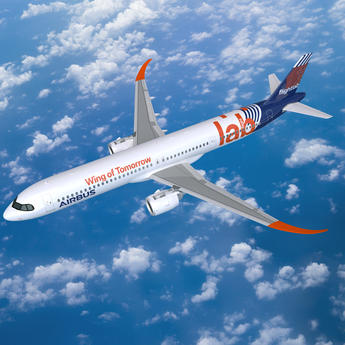
Airbus launches new flight test programme for Wing of Tomorrow
Press Release
Innovation
-

Air Canada and Airbus launch joint initiative to scale domestic Canadian SAF and…
Press Release
Innovation
-

Beyond the XLR: Stepping-up the next design evolutions across the A320 Family
Web Story
Commercial Aircraft
-

Airbus and MTU Aero Engines to create a joint venture to develop a fully electric…
Press Release
Innovation

