
Airbus launches new flight test programme for Wing of Tomorrow

Farnborough, United Kingdom, 21 July 2026 – Airbus is launching a new flight-test campaign to evaluate the performance of high-span wings for next-generation single-aisle aircraft, marking the next phase of one of its largest research and technology programmes, Wing of Tomorrow.
Over the next three years, Airbus will design, build and flight test full scale wing extensions. These will be installed on an A321neo aircraft and used to evaluate how the different wing geometries perform in real flight conditions.
The extensions, each measuring several metres, will replicate a folding wing in the fully extended position during a flight. They will be fitted with comprehensive testing equipment to capture behaviour in flight and evaluate how the longer wingspan impacts aircraft handling.
“For more than 50 years, Airbus has spearheaded aviation innovation, continually pushing the boundaries of what’s possible to deliver more efficient aircraft for future generations. This is why the Wing of Tomorrow programme is such an exciting and rewarding journey to be on”, said Sue Partridge, Airbus Head of Wing of Tomorrow programme. “Importantly, the wing is one of the biggest levers we have to improve flight efficiency, which is why the Wing of Tomorrow is so critical for our next generation single aisle aircraft. This flight-test campaign will allow us to safely challenge traditional design limits and explore the benefits of longer wings.”
Airbus is currently using advanced digital modelling and wind tunnel testing to finalise the designs of the wing extensions before they are tested in a representative flying environment. The flight data is critical to de-risk and unlock the full potential that longer wings could bring to next generation aircraft.
The Wing of Tomorrow programme is centred around creating longer, lighter, and more slender wings to maximise aerodynamic efficiency and reduce fuel burn. The wing extensions will be assembled at Airbus’ Wing Technology Development Centre in the UK and flight tested in Toulouse.
Airbus has already built three 17-metre (ground based) wing demonstrators to explore the advantages of increased wingspan and the benefits of more than 100 manufacturing and assembly technologies.
Since 2014, the Wing of Tomorrow programme has been backed by £227million in funding from the Aerospace Technology Institute (ATI) programme, a partnership between the ATI, Department for Business and Trade and Innovate UK, designed to maintain the UK's position as a leader in aerospace technology.
Note to editors:
- Alongside the engine, the wing is one of the biggest levers to improve aircraft efficiency. Airbus experts constantly examine new ideas and technologies, taking their inspiration from nature and helping to further optimise wing design for the next generation of aircraft.
- The Wing of Tomorrow is one of Airbus’ largest research and technology programmes, dedicated to designing and producing next-generation wing technology. It explores new wing designs to optimise aerodynamic performance, as well as new industrial processes to increase production rates and reduce costs.
- In parallel, Airbus UpNext is accelerating the eXtra Performance WING demonstrator, focused on developing a wing that can change shape during flight to maximise aerodynamic efficiency. The assembly of this flight demonstrator is nearing completion in Cazaux, southern France, with a maiden flight (remotely piloted) planned by the end of 2026.
- Both the Wing of Tomorrow and the eXtra Performance Wing demonstrators intend to advance wing technology for Airbus next generation single-aisle aircraft.
@Airbus #Wings #WingofTomorrow #NGSA #FIA2026

Farnborough Airshow 2026
Stay up to date with the latest news, stories and highlights related to the show.

Airbus press releases
Register to receive Airbus' latest press releases.
Related assets
Download
Documents
Airbus launches new flight test programme for Wing of Tomorrow
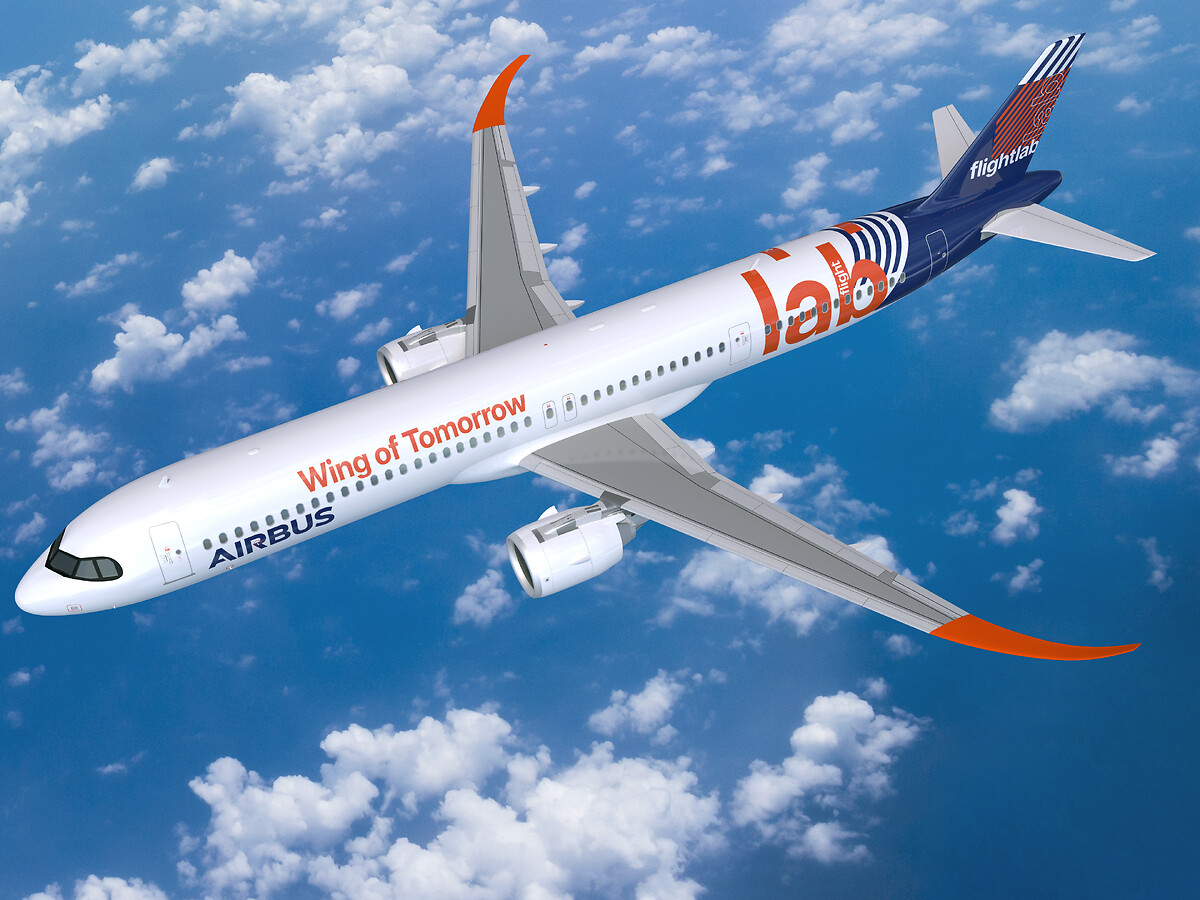
Wing of Tomorrow - Wing extension
Documents
Airbus launches new flight test programme for Wing of Tomorrow
Wing of Tomorrow - Wing extension
Contacts
Victoria Grayling
AIRBUS | Commercial Aircraft
Philippe Gmerek
AIRBUS
Discover more


Related news
Continue reading
-

Avolon orders 35 Airbus A330-900 and 75 A320neo Family aircraft
Press Release
Commercial Aircraft
Avolon, a leading global aviation finance company, has placed a firm order for 110 Airbus aircraft, comprising 35 A330-900 and 75 A320neo Family aircraft. -

Biman Bangladesh Airlines places firm order for A350-900 and A321neo Airbus aircraft
Press Release
Commercial Aircraft
-

FLYONE Armenia orders two Airbus A321neo
Press Release
Commercial Aircraft
-

Airbus A350F freighter successfully performs its maiden flight
Press Release
Commercial Aircraft
-

Airbus elevates hybrid-electric integration with LEIA Project
Press Release
Innovation
