
Airbus’ intelligent digital ecosystem on display at VivaTech 2026
How Airbus designs the invisible to protect the visible

Step behind the scenes of an invisible, multi-layered digital ecosystem stretching from the ground to space and designed to anticipate and neutralise modern threats.
Mention the name Airbus, and the mind conjures images of pioneering engineering – commercial and military aircraft, helicopters, or satellites far above in orbit. But behind the scenes, a different, digital revolution is taking place. Airbus has woven an intelligent architecture of protective products and services that functions as an invisible shield, silently working around the clock to safeguard people, critical infrastructure, and the planet itself.
Today, the line between the physical and digital worlds has become blurred. A virtual threat can quickly turn into real-world chaos. The different products that make up this invisible ecosystem thus work across four interconnected environments: on the ground, in cyberspace, in the sky and from space.
While this protective net is built of many innovative technologies, Airbus is showcasing several of them at VivaTech 2026.
On the Ground: ensuring public safety in everyday life
Physical safety has always been the highest priority of the aerospace industry. Engineers design dynamic and proactive layers that can provide additional security to systems that are already ironclad.

Take airport taxiways, for example. The Airbus UpNext Optimate demonstrator is a smart automation solution that acts as an extra set of automated eyes for pilots during taxiing. This reduces their workload and streamlines airport operations, quietly improving the passenger experience.
But protective technologies extend far beyond the perimeter of airports. When thousands of fans pack stadiums for a sporting match or concert, emergency services and security teams require flawless lines of communication. Enter Agnet, a mission-critical platform that integrates broadband and satellite connectivity, turning smartphones into encrypted network nodes for professionals, providing them with actionable data and improving situational awareness so they can reach the right people instantly and securely.
In Cyberspace: proactive resilience against virtual threats
A cyberattack or a piece of viral misinformation can have immediate, real-world ramifications for both public and private infrastructure. In the digital realm, Airbus isn’t just reacting to attacks – it's anticipating them.
For IT and cybersecurity teams preparing for the worst, CyberRange serves as the ultimate digital foil. This advanced digital twin simulator builds sovereign, 100% safe virtual infospheres that recreate a client’s own infrastructure. Teams can then stress-test their infrastructure against a variety of highly sophisticated, simulated cyberattacks, without ever putting any part of the real-world system at risk.
In parallel, cyber information warfare and coordinated disinformation campaigns powered by AI are becoming increasingly sophisticated. To counter this, the Airbus-led European project EUCINF – sponsored by the European Defence Fund – provides national and European defence authorities with key capabilities to protect their information space. This initiative is developing a flexible, interoperable toolbox composed of prototype-level software components designed for specific functions, ranging from data normalisation to mapping thousands of social media posts.
In the Sky: towards autonomous and more resilient flight
As global airspace becomes increasingly dense and complex, keeping people safe means rethinking how aircraft operate, communicate and navigate.

In emergency situations or demanding military environments, high-risk or high-burden tasks can be delegated by pilots to uncrewed systems, reducing cognitive load and physical risk. Airbus AI-enriched mission autonomy software orchestrates crewed and unmanned aerial systems (UAS) platforms in real time, enabling dynamic mission reconfiguration. This approach delivers rapid updates to operational technology, enhanced interoperability and AI-driven, multi-domain operations.
Did you know that one day, a pilot could use the unique information locked in the Earth’s magnetic crust to navigate? Airbus is exploring the potential of quantum sensors, which are extraordinarily effective at reading physical quantities – such as frequency, acceleration, rotation rates, electric and magnetic fields, and temperature – with the highest accuracy. Serving as a companion to Global Navigation and Satellite Systems (GNSS) such as Galileo or GPS, the sensors could bring an extra layer of navigational resilience. They observe the ground beneath with quantum precision, adding additional depth to existing charts.
From Space: providing the ultimate vantage point
The highest layer of Airbus’ intelligent ecosystem sits hundreds of kilometres above Earth. Satellites provide data addressing critical challenges such as the rising threat of climate-driven disasters and the necessity for global, failsafe high-speed communication .
When natural disasters strike, space-based imagery becomes a vital tool for emergency response. Airbus-built Sentinel-2 satellites, developed for the European Space Agency’s Copernicus programme, beam down data pertaining to floods, fires and earthquakes to guide rescue efforts. Beyond the immediate crisis, they serve as permanent sentinels, monitoring vegetation, soil health and coastal erosion. Meanwhile, Sentinel-6 tracks ocean conditions and sea levels, providing scientists with indispensable data to predict the impacts of climate change.

Yet even the most advanced Earth-based technology is useless without seamless, global connectivity. In regions where ground-based infrastructure is destroyed or non-existent, low-Earth orbit (LEO) satellite constellations fill the gap. Functioning as a global network of orbital relay stations, constellations like Eutelsat’s OneWeb, with over 600 Airbus-built satellites, provide high-speed connectivity to the most isolated corners of the globe. This space-based infrastructure ensures that first responders and communities in distress are never cut off from the help they need.
See the invisible come to life
This web of invisible technologies works silently behind the scenes to protect people, infrastructure and operations here on Earth thanks to the integration of ground, cyberspace, sky and space assets.
Want to see these technologies come to life? Join Airbus at Vivatech 2026 in Paris from 17-20 June. Visit our interactive booth and try your hand at spotting deepfakes, test your skills in an AI-assisted landing demonstration, or take the controls of an expansive and interactive Leap Motion firefighting simulation.
The ecosystem may be invisible, but the protection is real.

VivaTech 2026
We design the invisible to protect the visible.
17-20 June 2026 | Paris Expo Porte de Versailles
The latest Innovation news
Continue reading
-

Airbus elevates hybrid-electric integration with LEIA Project
Press Release
Innovation
Airbus elevates hybrid-electric integration with LEIA Project -
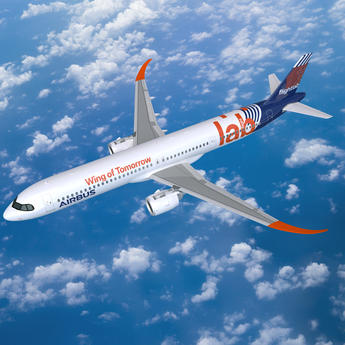
Airbus launches new flight test programme for Wing of Tomorrow
Press Release
Innovation
-

Air Canada and Airbus launch joint initiative to scale domestic Canadian SAF and…
Press Release
Innovation
-

Beyond the XLR: Stepping-up the next design evolutions across the A320 Family
Web Story
Commercial Aircraft
-

Airbus and MTU Aero Engines to create a joint venture to develop a fully electric…
Press Release
Innovation

