
A350F first flight: new freighter aircraft takes to the sky

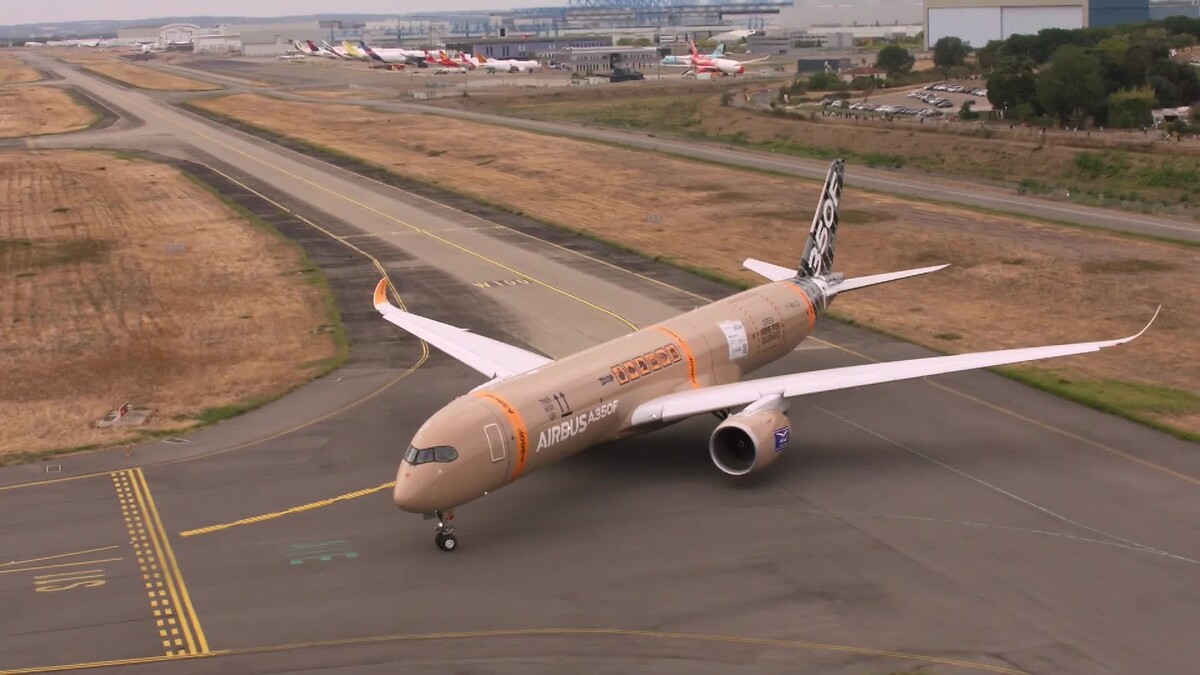
Today the first A350F aircraft – MSN700 – took to the skies for the very first time. This flight marked the beginning of the planned 10 month / 400 flight hour test campaign which will culminate in EASA Type Certification – paving the way to first customer deliveries of the world’s most efficient widebody freighter. As a new member of the A350 Family, A350F will deliver up to 40% lower fuel burn and CO₂ emissions compared with previous-generation freighters.

A350F MSN700 First flight - Take off
The crew of five on board were: Experimental Test Pilots Bernardo Saez-Benito Hernandez and Sylvain Guiraud; Test-Flight Engineer (TFE) Ludovic Girard; and Flight-Test-Engineers (FTEs) Laurent Bussiere and Jaime Angoloti Benavides.

A350F MSN700 First flight crew
Over the coming months, many more of Airbus’ flight test professionals will take part in the global certification flight test campaign – which feature two the complementary test aircraft:
- MSN700 will focus on handling qualities, autopilot systems and performance. This aircraft has been equipped with a specialised tail skid and bumper to protect the structure (from a potential contact with the runway) during the take-off performance tests.
- MSN701, meanwhile, will focus on system-related testing, including air conditioning, water & waste and comprehensive smoke detection testing. MSN701 will also perform the hot and cold weather campaign as well as visiting customers.
As of today, MSN701 has completed final assembly and is undergoing ground tests before entering the paintshop.
Celebrating a collective engineering excellence
Julien Puyou, Airbus’ Head of Widebody Programme comments: “From a bold vision on paper in 2021 to seeing the A350F fly for the first time today, this milestone is a triumph of pioneering spirit and collective determination.”
He adds: “Looking back at where we started when we launched the A350F programme, turning a revolutionary composite freighter design into physical reality has been an extraordinary human and industrial journey. Seeing our teams across Europe and beyond deliver breakthrough engineering – from delivering the largest main-deck cargo door in commercial aviation, conducting detailed large demonstrator testing, FAL final assembly, flight test instrumentation installation, ground testing, virtual development simulations and now the first flight in Toulouse – demonstrates what we can achieve when we unite around a shared goal."

A350F MSN700 First flight - Take off
What took place in the first flight?
The crew flew the aircraft for 4 hours and 10 minutes, during which they explored the aircraft’s handling characteristics in direct law, the engines’ behaviour, and core mechanical systems. The aircraft reached an indicated airspeed (IAS) of 340 kts and an altitude of 25,000 ft.

A350F MSN700 First flight crew boarding
Validating control laws against predictive models
The main objective of the initial flight is to validate and clear the aircraft's control laws by comparing real-time flight performance against the pre-flight predictive models that established the handling qualities. To this end, the crew took off in direct law which provides direct manual control.
They progressively climbed to 10,000ft then to 25,000 ft to evaluate the aircraft’s behaviour and confirmed that the aircraft’s actual aerodynamics and structural model matched the models which the crew had previously flown in the simulator. Once this had been achieved, and everything was within acceptable thresholds, normal law was activated, in order to clear the flying aircraft with its full flight envelope protections, and across the normal speed range.
Validating primary systems in flight
Aside from confirming the aerodynamic and structural characteristics, the crew also evaluated the primary systems such as pressurisation (measuring potential leakage rates against ground baseline tests), communication, and navigation to ensure they functioned as expected, thus paving the way to launching the broader flight test campaign in subsequent flights.
Real-time telemetry and the Flight Test Instrumentation (FTI) suite
Key to the aircraft's role as a flight-test vehicle is its Flight Test Instrumentation (FTI) suite – developed by Airbus’ own Electrical Centre in Toulouse and integrated into the fuselage sections in Airbus Atlantic in Montoir-de-Bretagne and Airbus Aerostructures in Hamburg. During a flight test the FTI tracks thousands of parameters on-board and conveys telemetry to monitoring teams on the ground in real time.

A350F MSN700 First flight crew boarding
After the flight, Laurent Bussiere, lead flight test engineer enthused: “We are now starting the flight test campaign and we're all very proud to be part of today’s mission. For all of us it’s a real milestone to be part of the first flight crew of a new aircraft. This aircraft is exceptional – its payload capabilities, fuel efficiency and flexibility show that it really will be a top freighter aircraft for all the airlines who will operate it.”
350F First flight - Best of Take off

Follow the A350F journey
Find out more about the A350F from manufacturing and behind-the-scenes engineering to the latest news, stories and customer orders.
-


A350F MSN700 First flight - Take off
-


A350F MSN700 First flight - Take off
-


A350F MSN 700 First flight inspection
-


A350F MSN 700 First flight inspection
-


A350F MSN700 First flight - Take off
-


A350F MSN700 First flight - Take off
-


A350F MSN700 First flight - Take off
-
A350F - First flight Take off
-


A350F MSN700 First flight - Take off
-
A350F MSN700 First flight - Take off


Download the infographic
Infographic
A350F infographic first flight
Infographic
A350F infographic first flight
Read more A350F stories
-

A350F first flight: new freighter aircraft takes to the sky
Web Story
Commercial Aircraft
Read the story about the A350F first flight -

Countdown to A350F first flight: Preparing for the sky
Web Story
Commercial Aircraft
-

Unpacking the A350F’s new livery
Web Story
Commercial Aircraft
-

Pushing the A350F to the limits: Ground Vibration Testing
Web Story
Commercial Aircraft
-
Where is the A350F built?
Web Story
Commercial Aircraft

