
Airbus awarded contract for Copernicus Sentinel-1 NG radar instruments at ILA Berlin

Berlin Air Show, Germany, 10 June 2026 -Airbus has signed a landmark €345 million contract with industrial prime contractor Thales Alenia Space, a joint venture of Thales (67%) and Leonardo (33%), on behalf of the European Space Agency (ESA). This agreement secures the development and production of two advanced C-band radar instruments for the upcoming Sentinel-1 NG constellation, a cornerstone of the EU’s Copernicus programme.
These advanced C-band radars will generate essential data for the global fight against climate change, providing millimetre-level accuracy to monitor sea-level rise, glacier movements, and land deformation. Unlike optical sensors, SAR technology operates effectively through cloud cover and in total darkness, ensuring continuous, 24/7 all-weather monitoring over both land and open ocean.
The next-generation radars represent a significant leap in Earth observation capability. Compared to the first-generation Sentinel-1, the NG constellation will feature modes with a much wider swath (400 km vs. 250 km) and a fourfold improvement in geometric resolution (5m x 5m vs. 5m x 20m). Furthermore, the new generation will extend its coverage to both poles, utilising advanced active beam steering through Multiple Aperture Processing Scheme (MAPS) technology.
“This contract is a ringing endorsement of Airbus’ expertise in synthetic aperture radar technology and, with a first launch expected in 2034, will ensure continuity of data into the 2040s,” said Marc Steckling, Head of Earth Observation, Science and Space Exploration at Airbus Defence and Space. “Thanks to their improved performance, the Sentinel-1 NG radars will enhance the existing services and applications but also allow the development of new ones, such as maritime surveillance.”
This contract continues the Sentinel-1 success story, following Airbus' role in building all four radar instruments for the previous Sentinel-1 satellites, with Thales Alenia Space as prime contractor, launched between 2014 and 2025.
Airbus will manufacture and test the overall C-band Synthetic Aperture Radar (SAR) at its facility in Friedrichshafen, Germany. While Thales Alenia Space Italia plays a major role in the SAR development providing the SAR electronics subsystem and T/R modules to Airbus, Airbus’ scope extends far beyond the radar itself. Airbus is also responsible for the spacecraft's mechanical, thermal, and propulsion subsystems, as well as critical mission performance engineering. The satellite will be based on Thales Alenia Space’s MILA platform, already used for other Copernicus missions such as CHIME, ROSE-L and CIMR. Thales Alenia Space will be responsible in particular for the assembly, integration and tests activities related to the two satellites.
About Copernicus
Copernicus is the Earth observation component of the European Union Space Programme, monitoring our planet and its environment for the benefit of all Europeans. It delivers accurate, timely and accessible information to improve environmental management, address climate change and support civil security. As the world’s most advanced Earth observation system, Copernicus provides continuous, free and reliable data and services to public authorities, businesses and citizens worldwide.
The programme is managed by the European Commission and funded by the EU, with additional contributions from ESA.
@AirbusSpace @CopernicusEU @ESA_EO #NextSpace #Innovation #Sustainability #SpaceMatters

Airbus press releases
Register to receive Airbus' latest press releases.
Translations and assets
Translations
Presse Information
Press Release
Assets
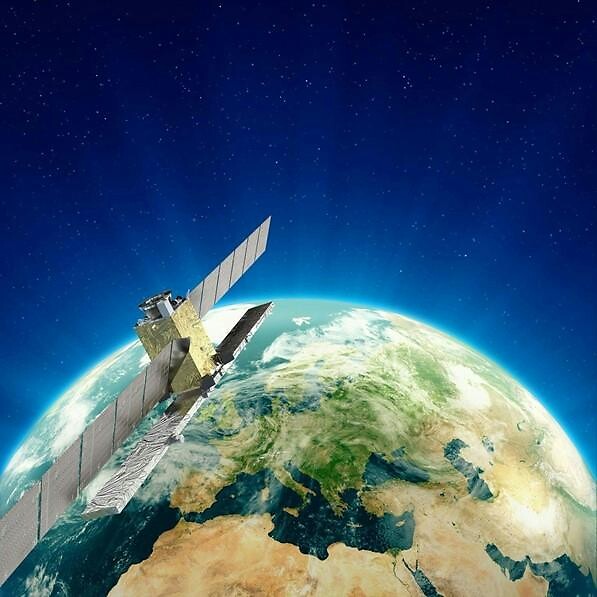
Sentinel-1-NG-CopyrightAirbus
- Translations
- Assets
Presse Information
Press Release
Sentinel-1-NG-CopyrightAirbus
Contacts for the media
Ralph Heinrich
AIRBUS | Defence and Space
Jeremy Close
AIRBUS | Defence and Space