
Beyond the lone aircraft: The power of teaming for life-saving operations

Airbus is challenging the "drones vs. helicopters" narrative. By combining human intuition with autonomous technology, a new era of teaming together crewed and uncrewed aircraft is transforming how we protect lives and landscapes during critical emergencies.
While drones are often viewed as the successor to the helicopter, Airbus is pioneering a different reality: one where the two do not compete, but collaborate. This advanced capability, known as crewed-uncrewed teaming, combines the endurance of uncrewed systems with the heavy-lift capability and rapid decision-making of a piloted helicopter.

Search and rescue missions: Finding the needle in the haystack
In the high-stakes environment of a search and rescue mission, deploying one solo helicopter to find a single person in a vast ocean is a challenge that demands precision. Through the use of teaming, a helicopter can arrive on the scene with several digital "scouts."
These drones fan out to scan the surface using computer vision and thermal imaging, while the helicopter crew focuses entirely on the rescue plan. Once one of the drones identifies the victim, coordinates are instantly synced, allowing the crewed aircraft to fly directly to the location to conduct the rescue operation.
A proactive shield against wildfires
Early detection is critical for firefighting in the face of evolving climate challenges. While a single helicopter can monitor one ridge, a helicopter teaming with a fleet of autonomous drones can monitor an entire forest. They identify "hot spots" before they escalate, enabling more efficient resource deployment and a higher level of safety for ground crews. The result is fires that are quickly contained and extinguished, protecting crews and communities alike.

The tech: Solving the cognitive load
The greatest challenge in the collaboration between drones and helicopters is managing the pilot's workload. Airbus has developed a specialised ecosystem called HTeaming which ensures seamless integration without overwhelming the crew. This solution features an intuitive, ruggedised tablet that can be integrated into a cockpit in just a few hours. The system relies on high-level autonomy where the crew "tasks" the drones with commands like "Scout Area A". The drone’s onboard intelligence handles flight paths and obstacle avoidance, freeing up the crewed helicopter to focus on the mission at hand. Additionally, encrypted, low-latency data links ensure the entire connection remains cyber-secure.

Experience meets innovation
This technology is far more than a theoretical concept. Drawing on decades of vertical flight experience, Airbus has conducted successful field trials with the Singaporean authorities, the Spanish Navy, and the French Armed Forces. These exercises prove that teaming performs effectively in high-stakes civil missions, increasing the safety of crews and the efficiency of rescuers.
The future of aerial support
We are moving away from the era of the "lone aircraft" and into the era of the integrated fleet. By combining human intuition with autonomous tech, Airbus is redefining what is possible in the sky.
The collaboration between drones and helicopters isn't just about a step up in technology; it also increases the safety of our crews, the efficiency of our rescuers, and the security of our borders. By combining the best of human intuition with the best of autonomous tech, we aren't just protecting people - we are redefining what is possible in the sky.


VivaTech 2026
We design the invisible to protect the visible.
17-20 June 2026 | Paris Expo Porte de Versailles
Discover more
-

Flexrotor: Nightwatch for the "Three Ds"
The Airbus UAS, Flexrotor currently serves as a tireless eye in the sky, supporting firefighting missions at night for Oregon…
-
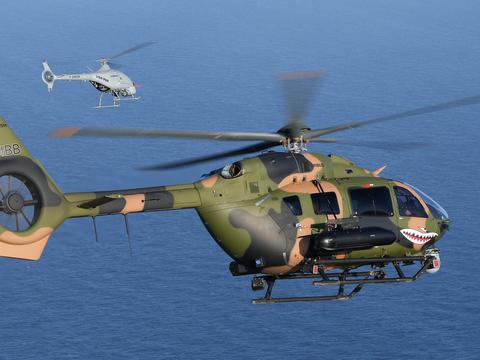
Helicopter-drone collaboration
Airbus Helicopters' Head of UAS Business, shares with Rotor magazine how crewed-uncrewed teaming enables our helicopters to…
-

Helicopters
Airbus delivers the most efficient helicopters to customers who serve, protect, save lives and carry passengers in demanding…


Related news
Continue reading
-

Amid the flames
Web Story
Helicopters
Super Puma operators battled Europe's extreme wildfire season, discharging over 122 million litres of water across major blazes in Spain and France. -

Romania orders 12 Airbus H225M multirole military helicopters
Press Release
Helicopters
-

Shaping the future of flight testing
Web Story
Helicopters
-

Saving lives with Ecuador's H145 "Arpías"
Web Story
Helicopters
-

A higher power to care
Web Story
Helicopters
