
Airbus at ILA: Ten breakthrough exhibits redefining aerospace

The Airbus Innovation story continues. After the Paris Airshow last year, this month we are at one of aviation’s largest events: ILA in Berlin. This air show, which traces its roots back to 1909 is an opportunity to showcase how innovation in aviation is the fruit of collaboration and partnership. It is impressive to learn how many experts it takes at each level of flight to make the aircraft happen.
We’re taking a behind-the-scenes look at how Airbus prepares the elements of flight: from novel and innovative materials to the design of digital twins for factory lines and robot assistance to support our operators. Let’s dive in!
When next-generation materials take wing
Airbus explores the science of structural integrity and environmental responsibility, focusing on maximising material reuse and minimising weight.
- Integral fuselage frame: Developed by Airbus, CTC, and Broetje-Automation, this frame represents a leap in Resin Transfer Molding (RTM). By consolidating complex elements into a single high-precision part, it eliminates energy-intensive climate control processes and enables higher production rates
- Materials blocks: A hands-on exhibit titled "Weigh me!" that allows visitors to feel the difference between traditional materials and lightweight composites. It demonstrates aviation's constant quest for weight reduction to lower fuel consumption.
- 3D-printed door latch shaft: An additive manufacturing marvel that replaces ten separate parts with one single titanium piece. Currently flying on the A350, it is 45% lighter than its predecessor, showcasing the immediate benefits of 3D printing in aerospace.
- Recycled titanium cylinder: Made from metal salvaged from end-of-life aircraft, this Grade 5 alloy cylinder highlights Airbus's ambition to optimise life-cycle considerations. Recycling titanium significantly reduces CO2 emissions by eliminating the need for primary mineral extraction.
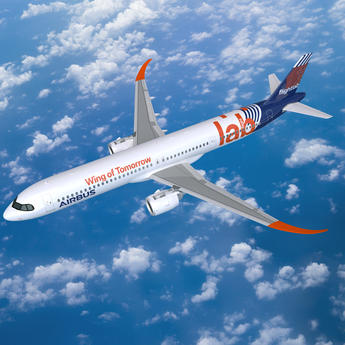
- Wing of Tomorrow (foldable wing tip): Inspired by birds, this programme designs longer, leaner wings for greater fuel efficiency. The foldable tips allow these high-performance wings to fit within existing airport gate infrastructure.
- Rotor hub model: Crafted from carbon fibre and PEEK thermoplastic for the H160 helicopter. This material offers superior fatigue resistance and a lower environmental footprint compared to traditional thermoset resins.
Propulsion and intelligent operations
Bridging physical hardware with digital intelligence, this chapter explores the evolution of mobility through hybridisation and hydrogen.
- Quantum navigation demo: A glimpse into ‘navigating the Earth's DNA.’ Using quantum sensors to read magnetic fields in the Earth's crust, this technology can provide a highly accurate, spoofing and jamming-resistant companion to traditional satellite-based navigation systems.

- Fuel cell mockup: The heart of the ZEROe hydrogen-powered aircraft. These cells convert hydrogen into electricity with only water as a byproduct, aiming for near carbon-neutral flight when using renewable hydrogen.
- AI gamified demo glasses: An AI-driven Large Language Model (LLM) that learns from a pilot's eye movements. This data helps predict responses to flight scenarios, feeding into digital twins and optimising future pilot training.
Innovation for the human factory
The final chapter looks at the modern shop floor, where operators are assisted by advanced simulations and robotics.
- CabinMarker shopfloor assistant: A versatile robot developed by Airbus Robotics. CabinMarker automates the positioning of aircraft seats, handling uncomfortable, repetitive manual tasks (kneeling and crawling) to protect the health and wellbeing of operators, keeping humans in the loop while improving precision.

- Digital twin technology: A digital twin is a digital fingerprint of an actual object or process. We combine advanced analytics, simulation, and artificial intelligence to populate and enrich these twins to help us optimise the physical object , in the case of hydrogen powered flight, to design the ideal architecture of a fuel cell engine.
These exhibits collectively demonstrate Airbus's pioneering spirit and our decarbonisation roadmap.
Stay tuned for the Innovation section of this Airbus website to stay up to date on the latest inspirations. You can also subscribe to the NOVA Newsletter and receive the latest in your inbox.

Airbus press releases
Register to receive Airbus' latest press releases.
Discover more Innovation news
Continue Reading
-

Airbus elevates hybrid-electric integration with LEIA Project
Press Release
Innovation
Airbus elevates hybrid-electric integration with LEIA Project -
Airbus launches new flight test programme for Wing of Tomorrow
Press Release
Innovation
-

Air Canada and Airbus launch joint initiative to scale domestic Canadian SAF and…
Press Release
Innovation
-

Beyond the XLR: Stepping-up the next design evolutions across the A320 Family
Web Story
Commercial Aircraft
-

Airbus and MTU Aero Engines to create a joint venture to develop a fully electric…
Press Release
Innovation

